
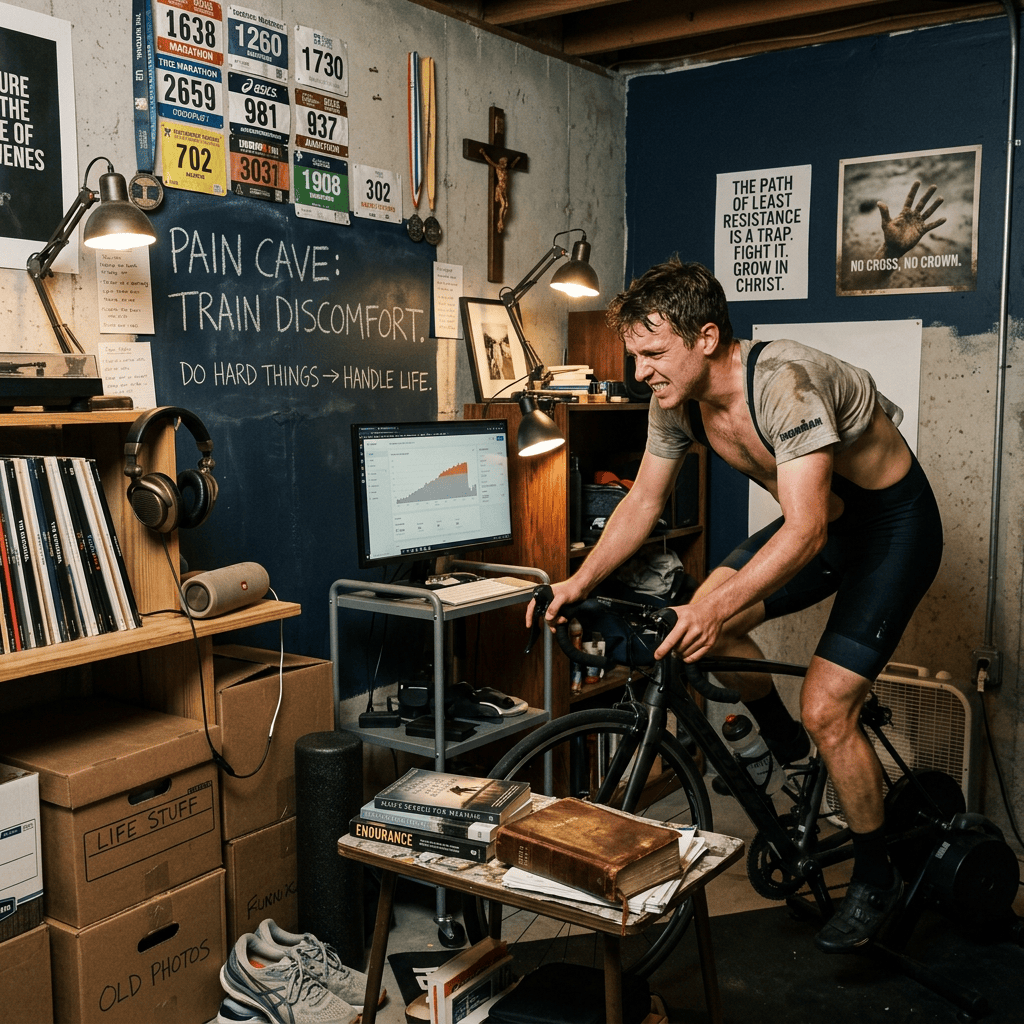
One reminder my college trumpet professor often gave me during our weekly lessons was that the body “will always takes the path of least resistance.”
He applied his axiom to the constant tinkering and reconstruction of my embouchure, a careful coordination of new muscle groups — all in the name of achieving a perfect, efficient buzz between my lips (which theoretically would lead to easier, higher-level performance … eventually). This process sometimes required forcing my face into unnatural positions. If I whimsically slapped my mouthpiece over my lips without consciously flexing my chin down, for example, I might produce a solid one-octave C scale in this moment, but I’d be reinforcing a flexibility-limiting position that would limit my capacity down the road. If I didn’t intentionally go against the grain now, when the task turned into slurring up from G to a double-high C, I’d be out of luck.
If this musical metaphor makes no sense to you, perhaps you’re familiar with the phrase, “pain cave.”
The ‘pain cave’ — made famous by Jessie Diggins and Courtney Dauwalter to name a few — represents the sporting antithesis to following the path of least resistance. Epitomized by the full-body feeling of discomfort every elementary school student experiences on the third lap of the mile run and every World Cup skier goes through on the penultimate trip up the big climb in Davos, the pain cave can also be found on the other side of the golf course — where no parents wandered over to cheer on their kids during a super windy middle school cross-country invitational in Jamestown, North Dakota. The pain cave is where, by virtue of pushing ourselves past the limit, the physical agony becomes so great that our self talk devolves into simply repeating the statement, “Why, again, am I making myself to do this?”
It’s actually a valid question. What’s the legitimate answer?
Here’s the thing. Humans love comfort. In fact, I would argue it is the North star most people follow in their quest for ‘the good life.’
Think about it. What is the ultimate payout we envision for all of the striving and discipline we subject ourselves to in life? We get good grades so we can get into a good college in order to get a good job so we can …..make enough money to …..? (disquieting pause)…..buy a nice house, have enough food, wear clean clothes and ……?…(*another uncomfortable pause) …..oh yeah, (obviously) grow a 401K big enough to really do anything we want during the ultimate age of comfort: retirement.
In our daily walk, we tend to avoid annoyances whenever possible. We hate getting sick. We love being in control. We want to be financially secure, keep the fridge stocked and drive dependable cars. We want to hear our beliefs propagated in the public square, so we listen to people we agree with and avoid those who might challenge our presuppositions. We read The New York Times or the Daily Wire. We flock to the cool kids and walk away from awkward people, conversations and/or situations. We sign up for things we know we can do and generally stay in our lane. Especially as we age, we refrain from placing ourselves in positions where we’re unprepared, don’t know what to do or think, have a high probability of failing and a low probability of exerting autonomy.
As we get older, the idea of going outside our comfort zone not only becomes scarier, but less logical. We lose our nimble sense of adventure at the same time we accrue wealth, freedom and power. This combination convinces us to avoidance anxiousness and quite frankly, precludes us from ever having to venture outside our safe spot.
Except if you are an athlete.
Sports is the artificial arena for voluntarily submitting to discomfort. It’s where we practice the skill of being comfortable in and with the uncomfortable. It’s where we learn to have composure amidst the collapse, to keep an even keel in the storm and to maintain emotional, psychological and physical equilibrium as we walk through the fire. It’s where we learned to tell ourselves, “you can do this,” or “you’ll be alright,” when our prefrontal cortex argued the opposite.
Considering we went from being a society that universally raised and harvested its own crops without the aid of modern farm technology to put food on the table (in a one-room log cabin most individuals built with their bare hands) to one wherein anyone can simply order a five-star, five-course meal from an app and have it delivered directly to their five-bedroom mansion 35 minutes later, I’d say this relatively unique benefit from exercise might be more relevant now than ever.
In other words, we’ve become so wealthy as a country that most people — unless accidentally or intentionally wander into a January night in Presque Isle, Maine, when the wind is whipping, and log a hard 10K in the classic tracks (even as their hands start to numb) — can avoid discomfort relatively easily.
“So,” you might think. “What’s wrong with that?”
“Why is it important to practice getting out of the comfort zone?”
“Besides,” all my imaginary 60-year-old skeptics continue. “I worked from 9-5, five days a week for 40 years for this! I ate canned beans, did my own lawn, never ordered takeout or went to the movie theaters and drove a 1997 Toyota Camry to 400,000 miles to get here! You’re just like every other lazy, bitter, naive millennial these days!”
Even if all that were true, hear me out. A few weeks ago, I was reading from my Bible in a Year. I came across this passage from Isaiah 48:10-11:
Behold, I have refined you, but not as silver;
I have tried you in the furnace of affliction.
For my own sake, for my own sake I do it, for how should my name be profaned?
My glory I will not give to another.
After explaining how it’s not sinful to inherently want good things and a comfortable life, Pastor Paul David Tripp wrote this in the daily devotional:
…”but if our desire for comfort rises in importance in our hearts and becomes the thing we live for, then we will find ourselves at cross-purposes with our Lord. God often compromises our comfort in order to produce something even better in us: godly character.”
So there it is. The purpose for the pain cave, perhaps?
Like I’ve said many times on this blog — and hopefully will express with pointed clarity in a soon-to-be written book on sports and sanctification — the patterns God has embedded into reality mirror those inherent to the athlete’s journey. In the same way pain produces performance (and toughness, resiliency, gratitude and a whole bunch of other transcendent takeaways) in sports, discomfort is valuable in our walk with Christ because it draws us closer to Him. For stubborn individuals like myself, trials are often required for us to trust God, lean into his promises and see our own flaws and mistakes. At the end of the day, tribulations — and real ones will occur in every serious sport story — are what God uses to shape and mold His sheep into the likeness of His son.
That’s why, by the way, the scariest prayer to pray is often, “God, grant me patience,” or “teach me contentment.” Whether we’d prefer it or not, He won’t magically tap us on the head with a wand to give us those traits like the Tooth Fairy. Instead, chances are, God will place us in a situation where we’re forced to learn patience or really understand why we can be content in all circumstances. It might be an injury. It might be a move to a smaller house. Either way, those situations are probably going to be kind of uncomfortable.
And that’s why we need a training ground to practice.
Regularly tapping into our pain cave on the field is how we remind our subconscious to not make decisions fully based off our own comfort off it. You learn to ignore your innate, self-preserving signals during mile repeats when you step back to the line for another rep not only so you can finish the workout, but so that you can build to something bigger. Likewise, sometimes in life we have to see through temporary pain for the long-term gain. After all, the path of least resistance might be what we’re naturally inclined to take — but, like my trumpet teacher said (often much to my chagrin) it isn’t always the best path.
The temptation in life is to choose comfort. But life isn’t about being comfortable. It’s about being (and becoming) Christlike.
And so, instead of avoiding the wind, the cold, the wet or the warm, put another layer on or take a different one off. Instead of believing it’s too hard, shrug off your insecurities and do your best. Instead of panicking or fearing failure, pause, take a breath and tell yourself, “You got this,” even if you’re not quite sure. Instead of sitting on a pile of stuff and staying in bounds, take a risk, let go, jump the fence and see what happens. Grow. Live. Instead of succumbing to the temptation to drop out when things start to hurt, press on. Instead of never showing up at the start line because you’re are scared to be embarrassed, frustrated or flailing, give it a shot.
Go hard. Go to the pain cave. But don’t do it just to ‘feel alive’ or sweat the sparkles off your brow. Do it because it’s a reminder that your refined in the fire — in this race and the big one. As an athlete and a person.
“We need sanctifying grace far more than we need comfortable lives,” Tripp stated.
I’m guessing this blog is being received in one of two ways. It’s either confirming and encouraging you, reader, in your decision to arbitrarily conduct an hour-long FTP test, hill climb time trial or mile-repeat workout this Tuesday — because you know its not just about VO2 max improvements…. OR … it’s being received as a challenge.
If it’s the latter, you’re welcome. If it’s the former, all I’ll say is this:
Keep on striving. Keep on skiing.


Leave a Reply