
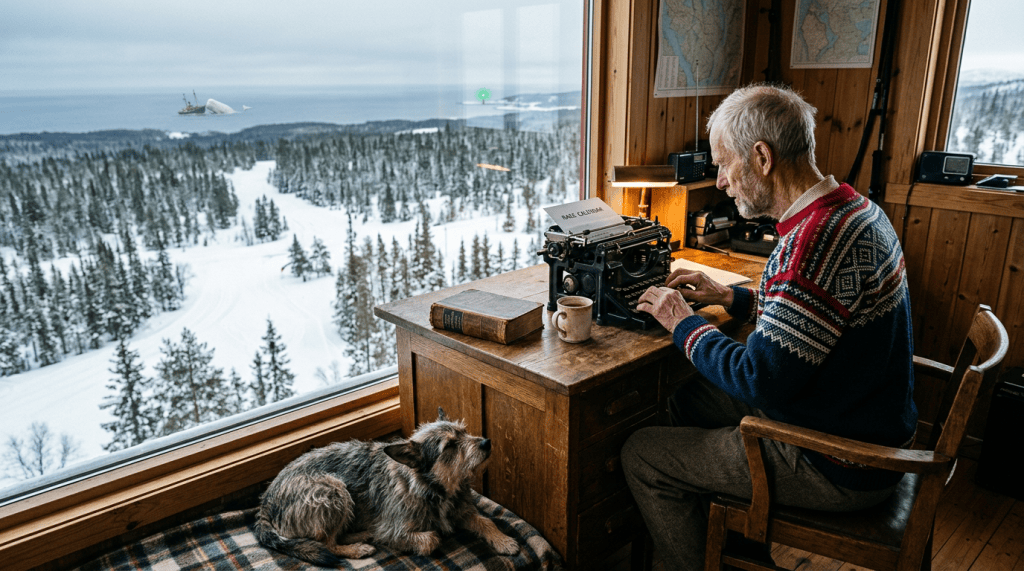
We plan for the next race season — buoyed by the hope of an eternal voice that says, ‘There’s always next year!’ — while simultaneously anchoring ourselves to the humbling truth that only God knows what tomorrow will bring.
“Well Bob,” a 13-year-old Ryan Sederquist once said, mimicking his favorite NBC announcer while sitting in the middle seat of an old GMC Safari. “There’s always next year!”
In order to pass the time during a cross-country trip from Minnesota to Banff back in 2004, my older brother and I invented the ‘Minnesota State Tournament.’ Using a 150 page Randall McNally atlas of the state, we organized 88 County brackets, pitting random towns against one another and making up stories about their state tournament dreams.
“The whole town has made the trip to Le Sueur for the first round of the Waseca County tournament!” I exclaimed, shuffling the four Queens and four Aces that would eventually determine each towns’ fate. The best of seven series was a random draw: team ‘A’ was assigned the Queens and team ‘B’ the Aces, and each card flip represented either a win or a loss. The entire ordeal took about 18 seconds. Dreams were dashed in the blink of an eye.
“This New Richland squad is starting two freshmen,” I continued in a self-constructed state of delusional amazement before quickly concocting a couple made-up boys’ names (and points per game averages).
“But the real story is the five members of the Johnson clan that have waited until their senior season,” I added, looking at my bewildered brother sitting next to me, who was waiting for an explanation.
“That’s right, quintuplets, what are the chances?!” I said. “Everyone is going to be following the Waldorf Wizards this year.”
It only took two years — and two trips to the Pacific Northwest (and another camping quest to the Grand Canyon and back) — to finish the inaugural state tournament, an affair which probably explains more about who I am than just about anything else. The champion, after navigating 11 rounds without a loss (like seriously, what are the chances?), including, appropriately, the very first Aitkin County bracket we wrote down in pencil in our stray sketch pad, was later immortalized in Seder-Skier lore: Shovel Lake.
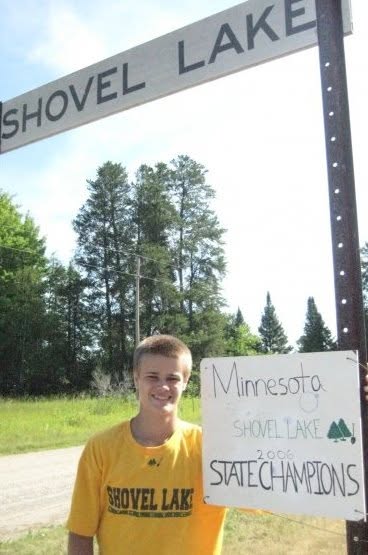
I visited Shovel Lake in high school with my brothers and a few friends. We painted a wooden sign that read: “Shovel Lake, 2006 Minnesota state champions.” That’s it. We hung it up. We took a couple photos. Five years later I went back to the town, which is really just a white sign by the Soo Line Railroad (although, it used to be an actual town, with a general store run by a man named Bill Russell, and I’m not even making that up!) when I was coming back from Wrenshall. I did a 13 mile run and then drove the rest of the way back to Moorhead. I looked for the sign, but it was gone. Sometimes, when I’m far away from home, I just sit and wonder where it is.
Over various travel trips for track and cross-country in college, I organized a couple more ‘state tournaments.’ Four in total. So, I guess I didn’t lie when I said ‘there was always next year,’ that first time. While Shovel Lake made an immaculate return to the state final (which, considering the field had to be dwindled down from around 2,000 places to just 64 state qualifiers — we cleaned up the county system after year 1 to make 64 ‘Districts,’ a clerical project that consumed an entire summer of trips to Bad Medicine Lake and back — is pretty amazing), I remember a couple towns that weren’t so lucky.
A few never made it out of the first round of districts.
“There’s always next year!”
This prolonged introduction may return to relevancy, or it may not, just like the town of Vasa. The ‘Vasa Boys’ — the Iron Five starters who played without a bench — had a chance to go all the way in 2006, 2007, 2008 and 2009. They had a chance, even when the cards were stacked against them in a very real sense (Tom and I failed to locate Vasa on the map until we were done making a 16-team county bracket. After finding a few other missed towns, we made a play-in game. Then a play-in to the play-in game. And, you guessed it: a play-in to the play-in to the play in, which Vasa navigated successfully, only to fall somewhere down the line. Sometimes the organizing committees, the state high school league — the government — is corrupt).
Anyway, as I’ve been constructing my 2026-27 nordic ski race calendar, the story of the state tournament (see what I did there?) as well as two metaphors from The Great Gatsby and Moby Dick keep coming to mind.
Scholars believe Gatbsy’s ‘green light’ represents his hopes and dreams — in particular, the idea of achieving the American Dream …and winning back Daisy, his true love. The light becomes a source of optimistic comfort. Meanwhile, the idea of the ‘White Whale’ has been borrowed from Melville’s masterpiece to describe any elusive goal, project or ambition that a person pursues — obsessively. Put those two things together and I believe you have the ultimate picture of what every Nordic skier feels this time of year.
At least for me, the very act of planning my season elicits a great deal of excitement. There’s a thrill to dreaming and scheming, of plotting out points along the path, like a teacher piecing together poignant pedagogically-appropriate plans for her students in an empty classroom on a July morning. Even this article has taken me awhile to produce. I’ve been working on it for at least 2 or 3 years.
I know what you’re thinking: This type of straightforward topic should take like 2 or 3 hours — max — not a couple years, right? Well, if all I was going to provide were a few tips on how to choose races and structure a season, then I suppose that would be true. But as I’ve wrestled with this topic, I’ve come to realize that the idea of a race calendar in general is one of those sources of optimism, an unsung driver, for all athletes. Not only that, it’s the ultimate metaphor for something way more important:
Having a vision for your life in general.
If you’re a ‘race calendar guy’ (or gal), you possess a mysterious motivational strand in your DNA. It fuels you through the ‘grind’ of weekly workouts and also pulls you past the mundane, daily tasks in your ‘real’ life. Why?
Because you feel like you’re going somewhere.
You sort of believe the Green Light will ultimately, in the end, lead you to Daisy. You think you might win the race series, get the globe, take the turkey trot. You are working as such. You are working for something bigger. In all aspects of life.
You’re saving money so you can buy land and then later build a Christian retreat center once your kids graduate from college. You get on the ground and teach or play with your kids because you wholeheartedly believe it will make a difference when, 15 years from now, they enter society as a grown man or woman. You head out with a headlamp to log another 2-hour double-pole session because the ritual is pointing to a bigger payoff, somewhere down the road. You believe in the process. You’re bought in. And, to be honest, it’s fun.
The excitement of what could be, what lies ahead, the vision we have — both in a single year or extended seasons or our entire life, in sports, careers or family life — spurs us to action, fuels our fire and colors our dreams. At the same time, the existence of a paradox — that there might not be a ‘next year’ — ought to humble us.
Our race calendar and life goals are predicated on the idea that we can think long term. But we also know tomorrow is not guaranteed. We know the markets could crash, a career change could happen, and we might end up living out your old age in a nursing home in Ransack Junction instead of in a cabin surrounded by worshipping Protestants. You could end up getting rear-ended by a texting teenager and lose your toddler tragically in a car crash. You could end up getting injured and never making it to the start line. Or maybe you’ll get there, only to realize you’re really not as good as you thought.
Alas, you press on towards the goal, just like the Christmas ornament I got when I was 9 says.
I was talking to River Radamus, a two-time Olympic Alpine skier, a couple weeks ago. Radamus is sort of the Brett Favre meets Steve Prefontaine of the U.S. alpine ski team. He’s a gutsy gunslinger. He races to win. Whenever he’s in the start gate, the U.S. Ski Team has a chance. He always lays it on the line, which means sometimes he’ll rocket from Bib 50 to 4th place and other times he’ll DNF. At the 2022 Olympics, he soared to a somewhat unexpected fourth-place finish in his signature event, the giant slalom. For the next four years, you can only imagine what was on his mind.
“I wanted to know — from the last Olympics to this one — that I’d done everything I possibly could to prepare for that moment,” the 28-year-old said. “And be able to feel that in the start. To be able to ski freely knowing that I’d put all the work I could in.”
In Italy this past winter, Radamus left his second Games with a 15th, 17th and had two DNFs. Knowing how he carries himself — as an athlete who believes he will one day be vying for podiums on a weekly basis — I asked him — as he enters his 28th year of life — if his mind has ever gone to a certain, particular dark place, one where you don’t ever get to the promised land.
“You have all the thoughts of, ‘Am I ever going to be good enough to do it?’” Radamus said. “Or reach the highs I have before or the ones I set out for myself.”
If you want to know his resolution, you’ll have to veer over to Vaildaily.com and check out my 1800 word feature.
Reflecting on Radamus’s words, I realized that in some ways, the younger you are, the easier it is to hold onto the belief that you will achieve your ‘Olympics,’ whatever that is — a certain career, a house, a bucket list vacation, a dream race victory, etc — at some point. And even if you don’t, the very fact that the goal appears elusive seems to provide its own eternal excitement, sort of like how Minnesota Vikings fans feel going into every new NFL season. If the Purple actually won a Super Bowl, none of us really know what we would do ….
As you get older, however, reality starts to set in. You see time slipping away, the sand draining down the capsule.
What if I actually don’t reach the pinnacle I’ve set for myself?
What if there’s a different final chapter to my sports story?
What if this resolves in a way I did not expect, with me taking a turn for the worse?
….with me not even finishing this race season – or with this race season being my last ever?
The longer I live, the more I realize just how important it is to cut against the current and dream big. But just as vital is following Radamus’s advice:
“I’ve always trained like I race, but now I need to race like train,” Radamus said. “I need to trust that I’ve put in the work and allow the good things to happen. Because my good is good enough.”
Even with his renewed perspective, Radamus hasn’t stopped wanting big-time results. In fact, he said it’s healthy to long for the top step.
“It wakes you up in the morning,” he said with a smile. “But I’ve found little satisfaction in chasing purely those results and judging my performance, my effort on how close or far I am from those results.”
Having spent 12 years on the national team, and close to 13 more on skis as a youngster trying to get there, Radamus said he believes he owes it to himself to keep the dream alive.
“And try to do it in a way where I can both dedicate myself to a crazy degree and push to my absolute limits and see what’s possible,” he said. “But also truly enjoy the ride.”
An excerpt from “My good is good enough: River Radamus has stopped skiing at 110% — and it’s starting to pay off,” by Ryan Sederquist, The Vail Daily, Nov. 26, 2026
Whether we’re athletes or not, we ought to have a vision for our lives, anticipate our ascension and believe our next big breakthrough is indeed right around the corner. But it’s almost equally as important to learn to accept the fact that you might never reach what you believed to be the ‘good life.’ It’s almost equally as important to trust that God’s plan is a ‘better life.’ I mentioned in my bonus Thanksgiving column that whatever you are going through is happening for a reason. A better way to phrase it perhaps, would be this way:
Whatever God is doing in your life, He is doing on purpose. Since he’s all-knowing, all powerful and all loving — perfect, holy and mighty in every way — this truth provides peace.
In sports and life, vision is vital. In sports and life, perspective is pertinent. We should have a plan (or better yet, ‘planSSS,’ plural) and work, sacrifice, love, sweat, bleed, save and strive to achieve them, believing we can. Believing we will. Planning as though it’s going to happen.
But we also must learn to accept the possibility that all of our dreams might not come to fruition. Yes, it’s a paradox. But if you haven’t figured it out already, life is pretty much one big paradox. We plan for the next race season — buoyed by the hope of an eternal voice that says, ‘There’s always next year!’ — while simultaneously anchoring ourselves to the humbling truth that only God knows what tomorrow will bring. And we might not be in it.
If we don’t learn to do this, we end up either achieving the ultimate goal and being completely disillusioned to its relative importance. Or, more likely, we’ll fail and feel bitter resentment. What’s even worse, and I’ll admit I’m tempted to fall into this category, is that we might feel genuinely depressed: we feel like failures in the truest sense of the word.
I think that’s why Radamus’ words resonated with me. I think he’s right in saying that if you can learn to accept this most unthinkable of possibilities, you’re freed up to lay it all on the line. You’re freed up to enjoy the grind and embrace the training, and hopefully pursue your own “Olympics” as though it will actually be realized. You’re freed up to be happy — all the time — no matter how the chips actually fall.
So, as you’re thinking about what races you want to do, I’d like to encourage you to dream big, to work hard, and to strive for true success. Plan for it, be energized by it, get excited for it. Embrace the mundane tasks with joyfulness and thankfulness because they’re part of the journey. But along the way, never forget that each day is truly a gift. And always remember your journey might not end where you think it should. After all, only one town gets to be Shovel Lake.
If you were reading closely, you may have noticed that in my extended intro, I said ‘two’ metaphors from ‘each’ book are relevant to race calendar construction. But I only listed one from each. There are two more worth mentioning now.
The first, from Gatsby: a children’s book.
Amidst Nick Carraway’s panic-filled planning of his friend’s funeral (spoiler alert: Jay Gatsby dies), the rich man’s father, Henry C. Gatz, shows him his son’s copy of “Hopalong Cassidy.” In the back of the ragged copy is a strict schedule Jay wrote out for himself.
- 6:00 A.M. – Rise from bed
- 6:15–6:30 A.M. – Dumbbell exercise and wall-scaling
- 7:15–8:15 A.M. – Study electricity, etc.
- 8:30 A.M.–4:30 P.M. – Work
- 4:30–5:00 P.M. – Baseball and sports
- 5:00–6:00 P.M. – Practice elocution, poise, and how to attain it
- 7:00–9:00 P.M. – Study needed inventions
“It just goes to show ya,” Gatz says to Carraway.
One could argue the regimen represents a self-made man’s faith in discipline, will and method. Juxtaposed with how things actually turned out for Gatbsy — his apprenticeship to a bootlegger, ties to a man who fixed the World Series, a friendless funeral, etc. — my transcendent athletic-related takeaway would be this:
We can do everything right and still not end up where we wanted, intended, or thought we would.
You can train really well, eat right, EVEN stretch your hamstrings and cultivate mental toughness and you still might get injured and never make it to the season opener. You can invest in your 401K, be frugal, live within your means and still end up not being able to afford that new car. On the flip side, you can do all those things and win an Olympic gold medal, become the fascinating Jay Gatbsy of your niche pursuit — the guy everyone wants to be around (or at least get a piece of) — and end up with no real friends or family at the final finish line. The ‘tragic’ truth, if we want to call it that, is that there’s no formulaic route which guarantees success. There’s mystery in life.
Mystery, that is, for us.
Back to Moby Dick. Back to the white whale. I may have already mentioned it, but I think I missed it. Let me explain.
The late, great theologian RC Sproul’s graduate thesis was titled, “The Existential Implications of Melville’s Moby Dick.” (As a side note, I’ve reached out to Ligonier Ministries and Dr. Stephen Nichols to obtain the original copy of this paper, as I could not find it on the internet. He replied and said he was sorry to say that it’s not digitized and probably never will be. Bummer.)
In writing about the topic in a blog post years later, Sproul stated:
If the whale embodies everything that is symbolized by whiteness—that which is terrifying; that which is pure; that which is excellent; that which is horrible and ghastly; that which is mysterious and incomprehensible—does he not embody those traits that are found in the fullness of the perfections in the being of God Himself?
Sproul isn’t the first person to posit Moby Dick as being God instead of — as some other experts think – the embodiment of evil. While I’m no Melville scholar, I trust Sproul. Besides, whether Melville meant it that way or not, I like the take. It makes sense, theologically. It also more accurately justifies and explains Melville’s insanely voluminous references to Old Testament passages, people and themes.
Anyway, the main point — the one relevant to race calendar building — has to do with God’s sovereignty, another thread woven throughout Ishmael’s narration. Some people seem frightened or turned off by the idea of God’s sovereignty. And I guess, I can sort of see their point. It seems, to them, that God is this violent whale who randomly exercises his power upon helpless creatures. I see it a little differently, though. Yes, God is both pure and terrifying, mysterious and clearly revealed. He might snip your achilles or miraculously cure your arthritis. And that unknown makes it hard to plan. It makes it hard to be a race calendar guy sometimes.
But…. if I consider the almighty God, the White Whale who demands my fear, as also being the God who loves me, knows me (better than I know myself) and wants what’s best for me, then I ought to find peace in His plan.
To wrap this all up, as an athlete, I think we ought to stare at our own Green Light — the symbol of my optimistic planning for the future, a hope-filled dream of the next great race, our next magnificent season and all that could be, down the line — and we can obsessively pursue (in a good way or an evil way) our White Whale of a trophy — whether it’s the Birkie, the Birken, the Tiny Town Turkey Trot or a cabin in Maine — jotting down our diligent brick-stacking in ragged training logs — our “Hopalong Cassidy” — empirical evidence of our grand vision. But in the end, we must do so while humbling clutching a paradoxical truth:
Your last race — the last season, the one from last winter — might have been your last one ever. There might not be a next year.
And if that’s the case, it is for the best.


Leave a Reply