

An essay on sports, parenting and my 2026 season that never was
*Editor’s note: This column was condensed — after three separate attempts — from the more than 110 pages I typed into a Google doc (mostly in October). That journal of reflections, ideas, quotes, stories, reports, musings and memories, etc., morphed gradually into a memoir of sorts, one which I hope to someday — when I’m out of the toddler trenches — clean up, punch up and whittle down into a text worthy of the title, “Stewardship in All Seasons.”
If this article doesn’t resonate with you, hopefully that book — whenever it gets written — will.
If, however, I never make it to that mini mountain top in my writing journey; if I never attain that lofty summit where I can collect all my thoughts and experiences; where I plan to make sense of it all and explain why I did what I did and thought what I thought — I should wish now to quickly point out something I believe to be profound and urgent (just in case that day of publication never arrives … in case these half-baked bricks on Seder-Skier.com never lead to a long and illustrious era of authorship and all anyone is left with are inadequate snapshots and incomplete entries like this one):
To Christie, Novi, Ella and Hugo — I’m sorry if there were times where it felt like I wasn’t always there. I’m far from perfect, then and now. But I love you more than anything else, then and now.
And to Ajeé, my loyal black companion: I know you didn’t have much choice in the matter, but I appreciate your willingness to always accompany me on those enlightening evening trips to the secret snow stash.
-The Seder-Skier
It feels like the universe is conspiring against me.
A nagging achilles injury knocked me out of the entire trail run season. I proceeded to half-mope through a 10-week paternity leave, which consisted of more Playmobil playing and less peak-bagging and than I’d originally planned. To top it off, Ol’ Man Winter is taking his sweet time. El Nino seems to be dropping snow everywhere… except here.
Oh well. At least I have my secret snow stash.
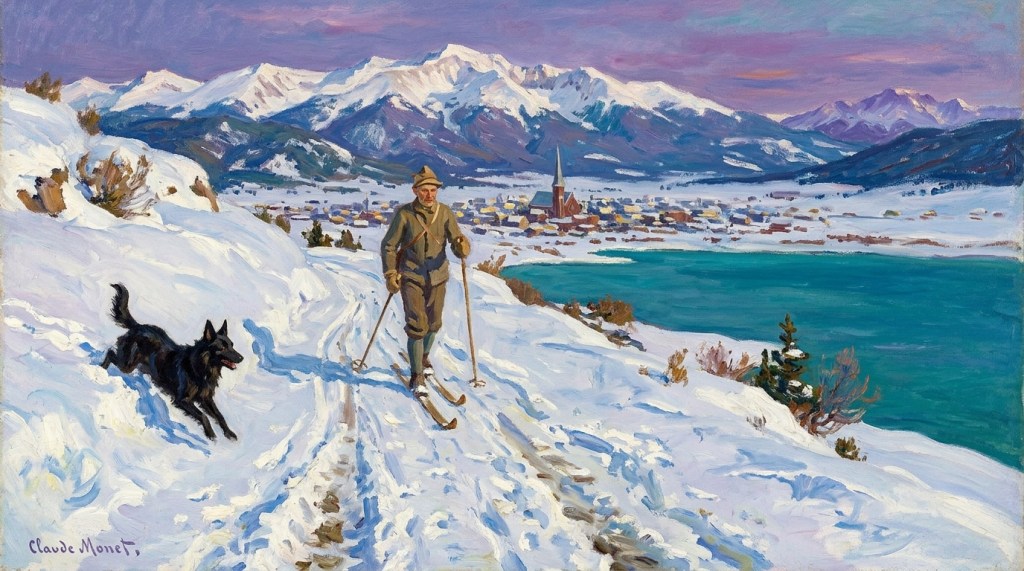
A shaded stretch of Turquoise Lake Road holds powder — which we received (once, an eternity ago) — better than anywhere else I know. The foot or so dumped upon Leadville a few weeks ago has provided a skinny ski sanctuary for local enthusiasts. A trio of double tracks wind up the frozen 3% slope from Abe Lee to Hagerman Pass, evidence of daily tandem treks, team practices and solo skis —my personal favorite.
One night, I head out alone.
As I work off my upper-body rust, monotonously double-poling my way within car-groomed grooves, sounds shift between 90s rap, “The Great Gatsby” and political podcasts (a motivational concoction if there ever was one). Sometimes, I ignore Eminem, F. Scott Fitzgerald and (insert whatever talk show host will keep you from abandoning this post) to mentally transcribe the Next Great American Novel. My protagonist, a mysterious alter-ego of sorts, a savant who calls himself Mack Chan, does everything I didn’t.
He talks back to coaches, steals candy from gas stations, lives out of a sprinter van and makes out with hot chicks without even thinking of courtship, much less marriage. He also performs bassoon concertos in Carnegie Hall and wins the Vasa, betraying his incongruous nomadic lifestyle every time he exhales his trademark phrase into the mainstream media microphones regularly slammed under the glow of his perfectly proportional forehead’s gold complexion:
“It’s not all glamour maaaaaaan.”
At times, I live vicariously through Chan. His existence also allows me to workshop various hypothetical situations, testing grounds for my beliefs and ideas, many of which end up somewhat sanitized by the time they arrive on this website. For example, there was the infamous conversation he had with his high school band director, an exchange which occured when Chan himself felt victimized by the universe.
“You can wish, or you can work,” the conductor told a stunned and silent Mack Chan. “You can complain, or you can compete. You can whine. Or you can win.”
pg. 231, “The Secret Life of Mack Chan” by Ryan Sederquist
With Chan, I could take my fantasies to their final conclusion, exploring what it would be like to have everything go right: to work and then win. To reap and sow — in season.
I could make sense of things my way. I could show it was possible to be a musician and an athlete; a mischievous, adventurous, selfish bad boy and a grounded, tender-hearted, sacrificial good guy; a successful, athletic specimen and a loving, well-loved family man. Near the end of the unwritten 878-page book (it’s got to be at least that long, I figure, to explain how a guy is playing bassoon in front of the New York Phil at one moment and skiing in Sweden the next), Chan comes of age and realizes what it was all about:
“I just want to say, you doubted us,” Mack blurted to no one in particular, but somehow, at the same time, to everyone who ever short-sold him in general.
“But now we’re here,” he stomped, spit flying into the microphone as frozen chunks of ice hung from his unruly mustache over the reporter’s windscreen. Chan’s suddenly playful imagination inadvertently wandered back home, back to the Canadian border, where he knew his loyal friend Joe — the only person who would understand the bit — would be watching in the pre-dawn darkness, having followed his comrade via online tracking, religiously marking those black checkpoints which reveal almost nothing about the real story of any race.
“Is that all?” the TV man asked in an unjustifiably uninterested tone.
“No,” Mack replied, ignoring the reporter’s apathetic countenance and instead relishing in the reward of this long-awaited moment, one he’d always assumed would never arrive. Chan figured this glorious consummation of everything he’d ever worked for, unexpectedly lived through, and dreamed of would remain permanently locked away as a full-fledged fantasy — experienced only in randomly mutated visions he’d maybe enter via migraine late at night, perhaps even years apart, until he finally ran out of time. Now, with the Kranskulla around his neck, reality returned. And with his tactile senses, a humble internal awareness of where he stood: the top of the Vasaloppet podium.
“All glory goes to God,” he said firmly, choking back tears. “All the credit to my wife. And all my love — to my children.”
pg. 823, “The Secret Life of Mack Chan” by Ryan Sederquist
As darkness descends, a slivery moon suspended above Mount Massive turns the pure white blanket beneath my boots into a grayish white. The murky skies exaggerated a Monet-like scenery, the mountain ridges accentuated against the cloudy colors around them. I can no longer decipher the difference between hazardous stray rocks and the reflection of stars speckled across my path. I flip my headlamp on and with it, an epiphany:
Sports is a lot like parenting.
“Gee, it sure is,” I mutter to myself between rhythmic breaths as I continue climbing. “Ain’t that something, Ajee. It just goes to show ya, doesn’t it Ajee?
“AJEE!”
I happily scream into the wilderness, spearing my call into the sky just for the heck of it — like an intentionally careless knight throwing his lance at no one in particular, just to feel the jousting motion, which he loves — craves even. I stop and listen. I slide an inch. Then, I stop again and stare off at the 14er ridge to the West. My mind drifts back to August; I feel the warm breeze against my tanned, salt-crusted skin, worn and wrinkled from countless trail run trips to the top. Amidst the crescendoing groan of winter, I’m desperate to gather up the dashed dreams of summer.
In athletics, few things are as rewarding as the feeling of standing on top of the mountain. Not an actual mountain top, per se, but rather, the metaphorical, singular summit of your season-long strivings. There’s nothing quite like setting a lofty goal, diligently pursuing it, and — after experiencing observable stepwise improvement — actually realizing it. But sometimes, the intoxicating process of daily brick-stacking ends without anything to show for it.
That’s the painful but ultimately transcendent lesson I learned this season. I pinned as many bibs to my Shovel Lake Running Club singlet as there are natural snowflakes currently attached to Meadow Mountain, the namesake location for a trail race that — like every other one on my schedule — began and ended with a DNS for the Seder-Skier.
Alone on the snow, I settled back into my metronomic quadrupedal motion, searching for answers in my stride and glide. My mind mirrored the parallel internal project of my cardiovascular system, where individual cardiac muscle fibers struggled to pull together and regain the heart’s steady-state rate after a most unnecessary interruption. Had every single summer workout faded meaninglessly into the mist?
My dog suddenly burst forth from a massive snow bank on the edge of the road. She bounded recklessly from the deep drifts into my wake, her German Shepherd instincts somehow sensing my momentary pause — a soundless signal, an automatic alert pinging her canine sixth-sense to check on my progress after a prolonged period of pet absenteeism.
“Dad,” my daughter had asked me earlier that day. “Can you play hotel with me?”
“Daddy has to go skiing with Ajee.”
“Dad,” she tried again, her tender heart fighting off the arrows of my last response, a guilt-filled, ambition-directed statement of Trumpian fake news. “Can’t you, one of these days,” she continued, her pleading eyes ripping my carnal desires apart, “stay home instead of going for a run or a ski?”
Just so you know, I hung around. I checked in, signed my name, ordered room service and even worked for a few minutes in the quickly constructed ‘business center,’ all the while monitoring the growing delay to my workout, the monstrous dragon I must slay every day, the festering, augmenting wart I’m compelled to pop on my priority totem pole of a nose, an ugly beak on my shame-filled face. Then it hit me: I definitely asked my dad something similar, probably 30 years ago. Something like, “Hey Dad, can you set up the trampoline for us?” Or, “Hey Dad, can you play catch with me.”
It only took me three decades to realize my dad only and always conveyed an aura of availability. Both of my parents did. It only took me three decades (and three kids) to realize just how simple and sacrificial that quotidian act was. It only took me three decades to do the math and realize how disproportionate their daily decisions’ demand was compared to the immediate payout.
Sports is a lot like parenting, I reiterated to myself as I checked my progress, glancing over the road’s dented metal barrier at the now-visible black waters of Turquoise Lake, a shivering slate 500 vertical feet below my skis. I could see the lights of Leadville and its picturesque church steeple pointing up into the stunning purplish haze, a painted-on backdrop which hung above the Mosquito Range. These heavenly colors created a postcard no one but me would ever see.
“Yes, yes, Ajee,” I said, buoyed by the gorgeous view and suddenly, in an involuntary manner, trying to sound like Jay Gatsby. “Sports is a lot like parenting, old sport.”
Sometimes we invest and get to reap the ROI in the form of peak performance perfection. Sometimes, we discipline, teach or bless our kids and see an immediate payoff, too.
Other times, we train and train and train and train … but never cash in or realize the point until we’re many, many, many more miles down the road.
Other times, we sacrificially love our kids in secret, seemingly with no impact, until — maybe 30 years later, when they have kids of their own — they call us up and finally acknowledge our efforts.
Presence is to parenting what patient, daily brick-stacking is to sports.
In athletics, we show up with our lunch pail every day to work, to improve. But we’re never sure if we’ll enjoy the fruits of our labor at the end of this season or the next — or another one, many years in the future, many miles down the road — maybe even on a different road (i.e. ‘sport,’ ol’ sport!). In parenting, we show up daily for our kids. But we’re never guaranteed the satisfaction of seeing our minuscule actions and major sacrifices pay off; we don’t know if our loving choices will impact our offspring now or go unacknowledged until much, much later. And yet, in both sports and child-rearing, we resolutely believe our determination and dedication to the whole enterprise is worth it. We decide, in both cases, to show up — every single morning.
No matter what.
As I continue skiing, the sounds in my headphones fade away, replaced by a conversation I think I had a few days prior, one which I hope went something like this:
“Hey Mom,” I said, fleeing from the riotous laughter filling our house’s messy playroom and escaping to the temporarily quiet deck out back.
“It’s great to hear your voice, Ry. How are you?”
“Oh man. Feeling a little like a failure,” I laughed, trying to hide the obvious truth behind my statement, one she already could have predicted because she raised me after all. “I never got that signature race with this injury and now I’m trying to get motivated to ski and it just won’t snow.”
As I waited to see how she would respond, I looked out at South Elbert, where I’d recently been forced, by snow — how ironic — to abandon my FKT reclamation effort 12 minutes from the summit. Another finish line never reached in a season full of false starts, dead ends, detours and unfinished business.
“And, I just,” I paused, shifting subjects slightly. “I realized I’m not as good of a parent as you guys were.”
“Oh that’s ridiculous,” the voice on the other end of the line said. “Why would you say that?”
“You guys were always there.”
In sports, brick-stacking happens because we show up — daily. We don’t make excuses; we don’t wish or whine. We work and and we (try to) win. We grind through mundane rituals because they’re the fundamental building blocks, the elementary toil that eventually adds up — either in this season or the next …or one many years away. It’s not heroic or glorious, usually.
Though now, in this day and age, social media seems to capture even the most average workouts in a way Christopher Nolan could jealous of. Now, in this day and age, as my AI-enhanced, Faulknerian cadence could suggest, if I let it invade my memoir:
“….in this age of our collective and unblinking exhibitionism, the digital ether contrives to capture even the most sweat-drenched, lung-bursting purgatory of an ordinary Tuesday jog with the bombastic, time-warped, brass-heavy reverberations of a modern cinematic oracle, as if some celluloid demigod in a tailored suit had set out to film the slow, agonizing decay of an old fence post and somehow made the splinters echo with the thundering, incomprehensible architecture of eternity…..”
yeah, like that
But ….generally speaking — for normal folks like you and I — brick-stacking isn’t fancy or Instagram-worthy. Mack Chan was right in knowing he possessed no special secrets to success.
“It’s not all glamour maaaaaan.”
Neither is parenting. Most of the things we do for our kids will indeed go unacknowledged, but we do them anyway. We change the diapers, we read “Llama Llama Red Pajama” for the 4,567th time. We correct. We spank (hey, I figure if you’ve invested this much time to read this far, you’re probably not going away now). We show them how to hang up their coat and tie their shoes. We play catch. We kiss them goodnight. We [don’t] sleep.
We are present. We show up. Every day. In every way. And somehow, almost as if God intended it, our offspring do notice that. Even if they don’t realize the significance. Yet.
It’s pitch black now at the secret snow stash, the place where I diligently plow forward with my Next Great American Novel; the place where I ski, train, chisel; the place where I think, contemplate, pray — mostly about, over and for the family I left in order to go workout. This is the place where I learn; the place where I discover; the place where I’m humbled.
I’ve turned downhill now, my triceps quaking and my stomach aching, hungry for dinner and answers. As I ride the well-earned glide, I look up at the snow-covered peaks — no longer available for running up — and dwell on the 2026 season that came crashing down. The season that never was. The season where the universe conspired against me.
My self-loathing is interrupted by another Act, a non-fictional moment I must have lived through once, a real exchange now morphing into a dreamlike scene with characters who talk, their voices blending in with the ‘swish, swish‘ of the snow:
“This is the mountain where daddy scraped his elbow and got all bloody,” my shy 3-year-old pipes up from the back of our car as I pack my running belt full of extra gloves, water and a serendipitously placed protein bar. I look at it for a moment, debating it’s worth, and then shove it between my phone, queued up with the next chapter of ‘Gatsby.’
That was November 1, 2026. We were at the Barr Trail parking lot. The place where my season had started, with so much hope, back in April (with the aforementioned blood-filled fall).
But more importantly, the mythical place where I’d planned to reach a pinnacle at the Pikes Peak Ascent and Marathon in September. A metaphorical and very real mountain top I’d enjoyed last year, largely because of the perfectly linear build leading up to it.
There’s nothing like reaching the mountain top, remember? Ain’t that right old sport? Don’t whine. Win. Work. Worship.
The jumbled mess of mixed messages — the kind I often encountered while solving the world’s problems on these evening skis — suddenly synthesized into a startling sports-to-life synergy through Ella’s unexpectedly vivid and bravely expressed recollection. Though I hadn’t reacted in the moment, now, at the secret snow stash, the whole incident jolted me, stoked in part by its surprising source.
Novi? She could fill a solo podcast with stories for 90 minutes (not sure where she got that skill from). Thus, if she happened to spit out a sentence like that, no matter how profound, it wouldn’t come as a shock. But Ella? She tends to bury her cares, interests, musings, talents and personality until they all blend together and strike, like lightning, in some darkened driveway — an abrupt, unheralded demonstration of grace, the gliding on a scooter, her leg held back in a magnificent, Michelle Kwan-like pose.
I’d practically forgotten that stupid spring trail run. A run that Ella — for whatever reason — had remembered perfectly. As I thought back, my mind combing over billions of neurological pathways — attempting to piece together fragments of the November 1 documentary it had previously stored away in the dusty archives of my brain — I pulled up a few images: my wife picking rocks out of the gash in my right arm, washing my red-smeared hip and letting it dry out in the damp spring air. Now, though it was months prior, I winced, not from the developing numbness in my ski boot, but from the scrapes of summer. And then, as I recreated the scene, setting characters on the stage the way they needed to be for this to all make sense — like it was a scene in “The Secret Life of Mack Chan” — I remember seeing Ella.
There she was. My middle daughter, Ella — shy little Ella — watching from a safe distance. Her beautiful little face, slightly tarnished by an adorable concern, said it all. Her eyes, weighted down by a burden I didn’t know her frame could bear, held the storyline to my season, the one I’d been searching for as I skied silently across my secret snow stash.
The entire image, coupled with my daughter’s memory of it 7 months later, revealed with incredible clarity the lesson I’d been longing to learn. She needed me. And what’s more, she knew she needed me. If I had died up on the mountain, I couldn’t be there for her ever again. I knew that, intellectually. She knew it in her soul. If I never came down from America’s Mountain, I could never show up ever again for her. She needed me to show up.
Presence and brick-stacking; sports and parenting — they were one and the same.
“Hey honey,” I yelled into my phone on November 1, about 90 minutes after placing the aforementioned protein bar in my back pocket and hauling it 9.2 miles and 5,789 vertical feet up Barr Trail — a hop, skip and a throw to the summit of Pikes Peak, a revered mountain I’d practically worshipped all year.
“I’m going to turn around.”
I couldn’t believe I was saying those words. I forced them out like a convicted toddler caught in the act of the sinful destruction, of his brother’s carefully constructed wall — a wall made of diligently stacked bricks.
Had this been the Pikes Peak Ascent, which was held a month prior — without me — my splits on this day, November 1, would have put me squarely on the podium. I felt super fit, super fast. All that brick stacking. For nothing. Or maybe, for everything.
I ripped the wrapper off the protein bar, took a bite and started the long downhill trek back towards the car. Towards Ella (and Novi and Hugo and Christie and Ajee, too). Incoming snow — how appropriate, if not ironic — had stifled my mission. Or crystalized it, depending on how you look at it.
“The universe isn’t conspiring against you,” my wife would remind me over coffee the next morning, as she often felt compelled to do when I uttered sarcastic theologically heresies. I intentionally placed these blasphemous exclamation points at the end of my meaningless, tired liturgies, ones I subconsciously crafted for the sole purpose of mourning my dead-and-buried 14er FKT attempts — like the one at Pikes on November 1 and the other one on the South Elbert Trail back in October.
I smiled back and grabbed my Bible — the source of all the real secrets, about sports, parenting, sovereignty and the universe — from the coffee table. Then I sat down and strapped on my Normatec recovery boots.
“I know,” I said, breathing in the majestic sunrise over Elbert as I sipped black energy out of my Skieologians cup. “Live to see another day.”
As I finished my sentence — one uttered just a few weeks prior by Seth DeMoor (the guy who stole my South Elbert FKT to begin with) when he had to turn around on a different 14er run because of snow — we heard a door at the end of the hallway slam shut. My wife and I paused and took in the warm silence.
We listened with loving anticipation for the second part of another daily routine, one I’ve gradually grown fond of, especially this year, 2026: the sound of four feet scampering down the wood floor towards us.
It’s the sound of sisters sprinting together, totally sure, in a beautifully innocent way, of a truth no one ever needed to teach them. Of a truth none of us ever learned, but all of us always knew, long before we pondered it for hours on solo ski trips up and over our secret snow stashes. It’s a bare truth, as naked as our body at birth — the moment we first felt it:
Mom is there. Dad is there. Our Father is always here. There. Everywhere.
It’s true: My 2026 season wasn’t what I expected. After starting at Pikes Peak in the spring, I thought I’d strive all summer, grow a little each day and come back to America’s mountain in the fall for that perfect ending. In the end, that is what I got. I did see a payoff, right there on Barr Trail. It just wasn’t what I’d hoped for.
It was even better.
“The End.”
Thwack!
Chan slammed the children’s book shut, an evening ritual he relished because it elicited a smile from his shy middle child.
“Off to bed, kiddos,” he said.
“Daddy! Do your gorilla strength!” Silja said.
“Gorilla strength?!”
His children, almost asleep from receiving their nightly allowance of two books, quickly came alive.
“It’s not like I double-poled 90 kilometers or anything,” Chan remarked, watching as his wife smiled and disappeared with the couple’s third child into the next room of her Swedish parents’ home.
“Alright, gorilla strength it is.”
Chan hoisted his two daughters, one in each arm, and stumbled down the hallway into their bedroom. Silja grabbed onto the bunkbed and pulled herself up. Then, Chan gently laid Ebba on the bottom.
“Dad,” his oldest daughter said from above. “Do you remember the first time you went skiing?”
“I sure do.”
“Where was it?”
“The Adirondacks. You know that. I’ve told you the story.”
“I know,” she replied. “Dad?”
“Yes, Silja.”
“Did you always think you were going to win the Vasa?”
“Ha. About as much as I thought I’d play bassoon at Carnegia Hall,” Chan replied. After he noticed the dumbfounded stare from his two daughters, he grew more serious.
“No my dear,” he continued. “In fact, pretty much everything I’ve ever done I never thought I’d do. I don’t think I could have planned it out this way if my life was just a made up story.” He paused briefly, then added in a whisper. “A fairytale.”
“Dad,” Silja said again, sparked by the idea of fairytales. “Can you tell us a story?”
“You just want to stay up later,” Chan said, smiling. The sound of blankets ruffling filled the silence as the two girls curled up under their covers.
“Yeah, yeah,” Ebba said, suddenly spirited. “And have a prince and a princess.”
“And make it about skiing, too,” Silje said, her 5-year-old brain clearly unable to think past her witnessing the glorious events of that day.
“Alright…. You and your stories.”
Chan, weary and suddenly starving, sat down on the bottom bunk and began:
‘Once upon a time, there was a young prince who liked to ski. The young boy often wandered off into the mountains with his grandfather’s old wood skis and slid up and down the roads way beyond the sheep’s pasture.”
“Sheep?” Ebba said curiously.
“Yes, there’s sheep. Can I continue?”
Both girls nodded, their eyes glazing over once again.
‘He liked to ski up there at night, in the evening glow, with the mountains staring down at him. He liked to ski up there with his old dog, a loyal friend named ….
“Beanbuckets!” Ebba squealed.
‘Yes, that’s right. Beanbuckets. He and Beanbuckets would ski on their secret snow stash all through the cold, early-December evenings. Sometimes, he would go up there to make up stories. Other times, he would go up there to invent things or solve problems or think about ways to respond to his sister whenever she said something snarky.’
Chan almost laughed at his own tale, and when he realized his words were wafting way past his children, he felt emboldened to continue his narrative wandering.
‘He would go up there and sometimes just pray. Or just think … about all the things …
Chan glanced down. Ebba’s eyes were closed. He stood up. Silja’s were, too.
‘…..he was thankful for….’
The door creaked open and the family’s dog, a skinny black wolf-like creature with long legs, a wispy jacket of fur and rugged, pointy features, sauntered into the room.
“King, you like the story?” Chan said, mostly to himself. He got up to leave the room and tripped on Silje’s backpack. A children’s book, ‘Over and Under the Snow,’ by Kate Messner, slid out. Chan picked it up and read the scribbles on the back cover:
Novrember FIRST
9 a.M. BrEFklst
10 a.M. GOski
11 a.M. paintanddoart
luNcH
“It just goes to show ya, doesn’t it,” Chan said, petting his dog and walking out of the room. “It just goes to show ya.”
Pg. 878, “The Secret life of Mack Chan,” By Ryan Sederquist
About the author: Ryan Sederquist is a Christian, husband, father, writer, podcaster and endurance athlete who lives in Leadville, CO, where he runs up mountains and skis along secret snow stashes, thinking mostly of topics to write about… but occasionally, he drifts off to dream about what it would feel like to win the Vasa himself. In middle school, he was warming up for a cross-country race when he saw another team donning long-sleeve shirts that said — and he’s not even making this up: “Train Hard And Soon Your Day Will Come.”
He still believes it.


Leave a Reply