
When I was a little kid, my mom brought me and my friends to the state cross-country meet. I still remember parking the car in some faraway lot on the outskirts of St. Olaf and sprinting across Winthrop’s ‘campus on a (huge!) hill’ alongside hordes of other procrastinators to catch ‘the gun.’
Whether we saw the start or not, my brothers and I and our two childhood best friends — Adam and Lukas — were consequently swept away by the crowd’s currents, an inexorable force dictating our first cheering post: the mile, of course, because it’s the only spot with a tangible measurement of feedback — a crowd-to-competitor connection we all can relate to.
After the leaders seemingly sprinted through the checkpoint in 4:50 or faster — unthinkable times for our prepubescent selves — we dashed across lumpy soccer fields, vacated rectangles hibernating for a higher cause, following middle-aged coaches harnessing the event’s energy to relive their own teenage stride, which they checked meticulously; following inexperienced, nervous moms wearing way too much for the unplanned physiological demands; following dogs on leashes, kids who should be and grandparents who wished to supernaturally be pulled ahead to a spot on the straightaway heading towards the West side.
Everyone feels the oncoming stampede. Everyone knows we’re all, in essence, now racing the race. Everyone knows our speed will dictate our position along the sideline. Farther down is better, because one can more easily move from there to the finish, where cautious folks are already headed, willing to skimp out on cumulative viewing spots for prime real estate elsewhere.
The peloton whizzed by into the wind, the top dogs tactically toying with one another along the never-ending straightaway. Some tucked in, letting their enemies block the breeze. Others jolted to the front, surging strategically, testing their foes to see what remained entering the third mile — the hidden part of the course where almost no fans ventured. Unlike other sports, in cross-country, the major moves, the crux of the course, the play of the game as it were, is rarely witnessed. Any fans or coaches or parents wandered along those remote tangents did so sacrificially, laying down their desire to know how the finish shook out in order to offer a much needed clap to get a runner there in the first place.
“BE TOUGH!” they’d shout, lifting up and digging into poor, puberty-laden souls simply trying to not embarrass themselves, much less find their true selves through the sport’s lung-searing demands.
I never once went over to those third mile trails until much later in life. Probably 15 years later. I ran over them during a 15-mile training run when I was a grown-up collegiate runner. They seemed smaller then, but just as far away — kind of like how all our high school memories inevitably take shape as we age. As my feet crunched against leaves I never squashed as a prep runner, I thought back to those state meets I watched as a kid.
Instead of following the daring few who went to the third mile, I always jockeyed for position on the bleachers with the rest of the big city folk. Usually, almost miraculously — like the way Christmas presents are eventually opened when you’re an impatient kid at Grandma’s house, doubting you’ll ever get to open that new Matchbox car as you anxiously wait for all the relatives to wrap up their long, meaningless conversations over hot coffee or hot apple cider — I made my way through the four-deep sections to snag a view of the chute.
Amidst the cowbell clangor, whipping of windbreaker jacket arms pumping, high-pitched screams and phlegm-filled coughs, I sprinted towards the finish — as a fan — feeling butterflies buzz in my stomach as if I were competing. Cross-country is a participatory sport for spectators, but that’s not only because they have to run to see the action. Spectators end up actually breathing in the sport, too. They taste the nerves. They sense the anticipation. They feel the unknown.
Whenever I’d get to my finish-line spot, wherever it ended up being, I would quickly scan towards an opening across the soccer fields where the first runners would escape from the woods, like a violin virtuoso finally emerging from the wings of Orchestra Hall for a much-awaited concerto performance.
One time, about 7 or 8 years after I went to the state meet as a kid, my friend, Lukas, emerged from there first. He’d been our team’s No. 2 guy the whole year and finished third at the section meet a week prior to state. I came to watch the race as his teammate, a junior on the squad.
I raced around to all the spots we used to go to when we were kids, all the while remaining oblivious to his contention and intentions. When I got to the finish line — earlier this time than in the past, probably because I was in the prime of my athletic life, right at the crossover point where I should have actually been in the race, not watching it — I looked right to the trees. I waited. My heart rate climbed. Then it skyrocketed.
My friend — the one I was homeschooled with in second grade, went to Vacation Bible School with in third grade and slept over with in the backyard after a Redhawks game the summer after fourth grade — was in first.
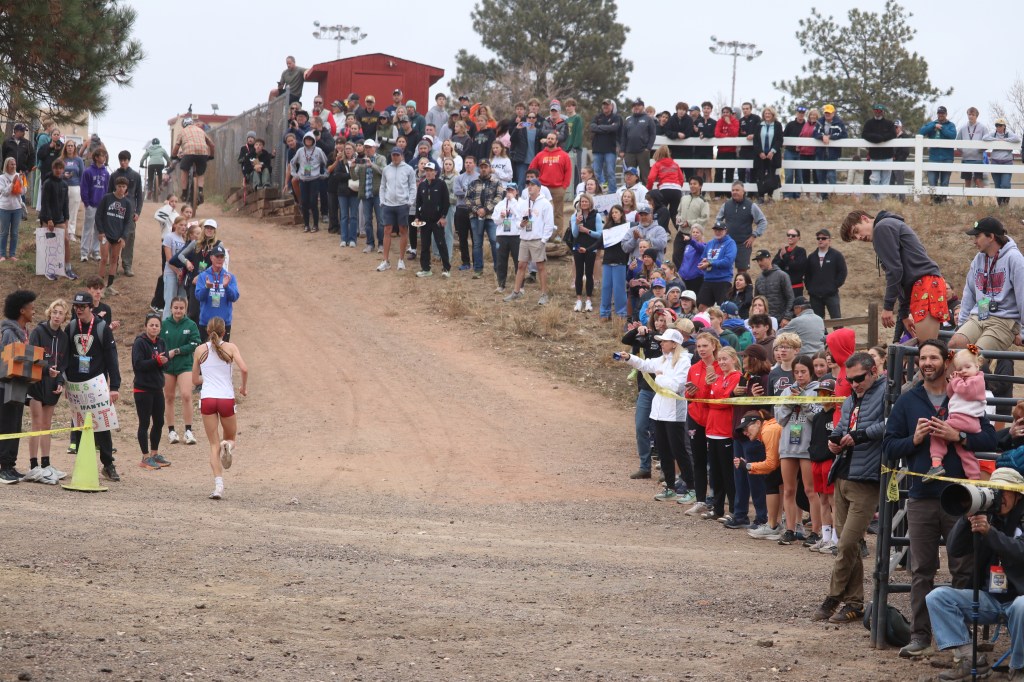
Yesterday, I came to the Colorado state cross country meet for maybe the sixth or seventh time. I’ve been at Norris Penrose a few times as an assistant coach and a few more times as a sports reporter. The last few times, I’ve brought my kids, indoctrinating them in the magic of the Great Runner Get Together even earlier than my parents did.
They spent most of the day at the park or standing by car, intentionally parked at the 800-to-go spot, way off in the distance, Norris’ version of St. Olaf’s hidden trails. Just like every good state course, Norris Penrose has some essential, heart-thumping, anticipation-inciting qualities.
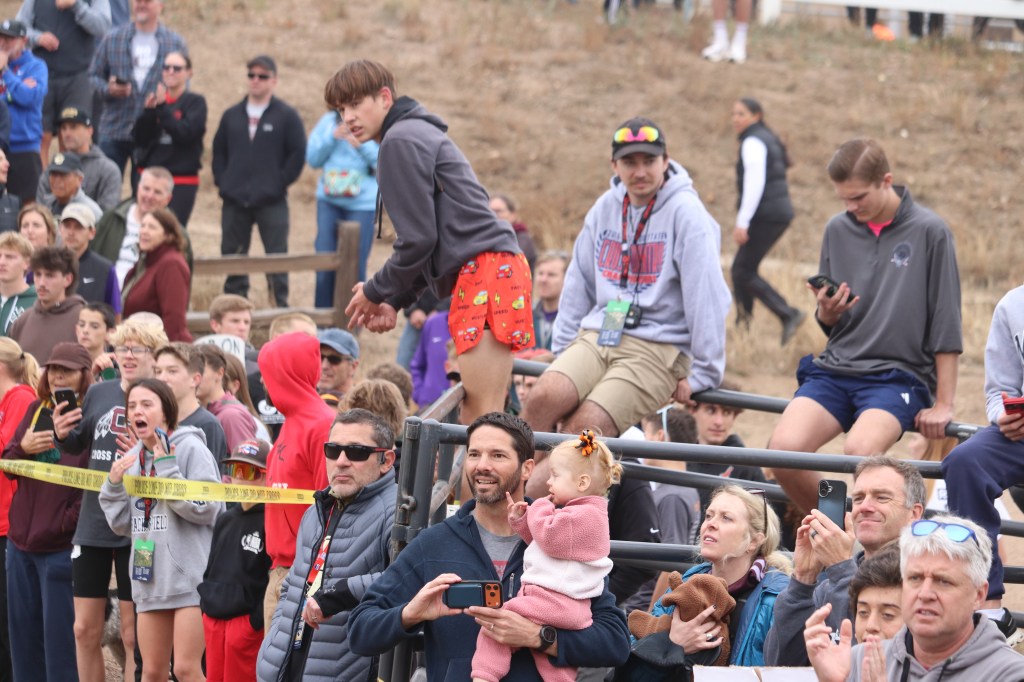
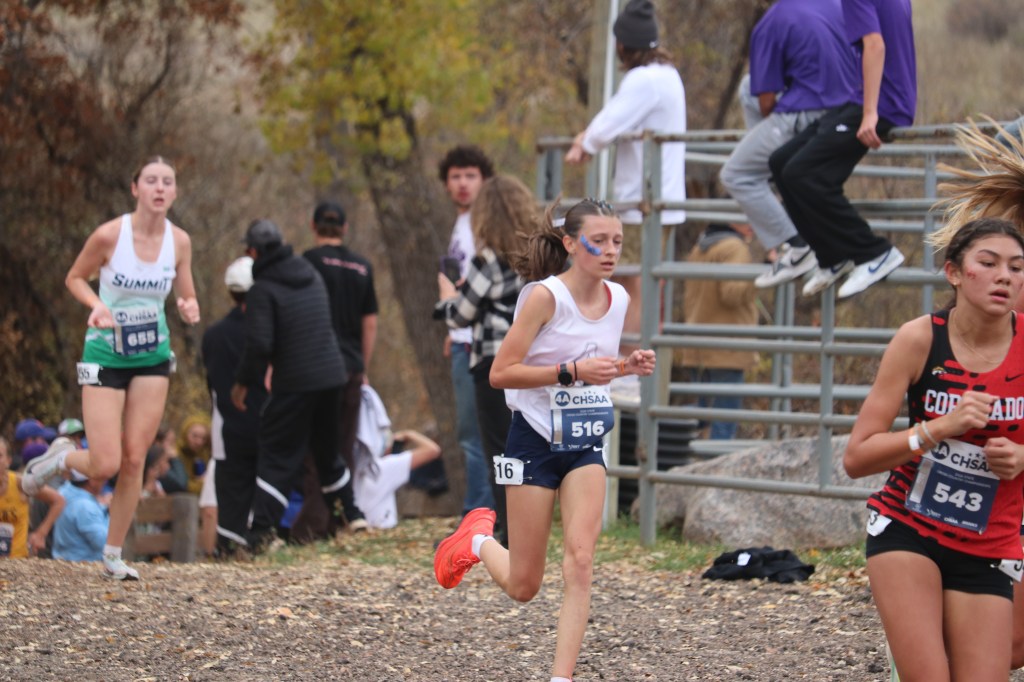
It’s very spread out, first of all, which means fans have to make choices. The mile and two mile splits are standard gathering grounds since they’re right next to each other. But if you stick around for the latter split, you have to descend a steep, off-trail, off-camber hill into a ravine, tip-toe across a few different logs and then hop across a river before ascending a 65% pure mud pitch to get to your ‘finish’ line view. Once you’ve done that, and your heart will be pumping for more than one reason, you can high-tail it to the stadium to see the actual finish, or, do what most people do: climb along the horse fences lining a river crossing, the unveiling point for runners emerging from their own ‘hidden’ trail section into a steep, gut-punching final climb to glory.
At this year’s state meet, I had no skin in the game. I wasn’t coaching a team with state-title aspirations or expectations, as I had in 2015, 2016 and 2017. None of the athletes I was covering were in contention for a state title, like they were in 2022 and 2023. I had no kids in the race obviously. Thus, I wasn’t in much of a rush. Still, I got swept away. As I crossed the river and moved towards the fence, I couldn’t help but feel strangely connected to what was happening.
In some ways, you could argue every sport is sort of like this. I was in person when Garrett Johnson sunk the game-winner in the section title game 25 years ago to send the Spuds to state, back when going to state actually meant something. The rafters of the packed Fergus Falls auditorium nearly collapsed in the pandemonium. If you were at Game 7 of the 1991 World Series at the Metrodome, I envy you. I can only imagine how palpable the tension was then.
Still, no other sport is quite like cross-country. No other sport demands its spectators to integrate into the race quite like it does. And as a result, no other sport makes its spectators feel like they’re really a part of it.
In this day and age, where boomers eat hotel breakfasts alone, scanning their phones as they digest NBA highlights that may or may not — whether they even realize it — be AI generated, maybe it’s time for more people to get outside to watch sports. And not ‘Friday Night Lights,’ a meaningless phrase for today’s generation, which only silently congregate at stadiums if it means they can take in their regularly-prescribed Tik-Tok doses. In a time where watered-down brackets and expanded fields has certainly dulled the objective meaning of a state appearance, at least in my opinion, somehow, the state cross-country meet still delivers.
At least, that’s what I realized on Saturday. If you haven’t been to one before, do it before you die. You’ll see what I mean. Even if you’re not a runner, go and watch. But if you do, let me give you some advice: show up on time. That way, you won’t have to run quite as hard from the parking lot to your first spot.


Leave a Reply