
Different eras, same mindset — total inspiration
Matt Carpenter used to feel the Pikes Peak Marathon weekend approaching in his bones.
“I always knew it was ‘about that time,’” he said of the event, which is being held for the 69th time on Saturday and Sunday. Carpenter holds 18 titles, including double ascent and marathon victories in both 2001 and 2007. These days, the Colorado Springs Sports Hall of Famer barely monitors the trail-running kingdom he ruled for nearly three decades.
Running provides a private source of personal edification for the 60-year-old. He knows he won’t get a medal for extending his daily 60-minute run streak — which reached 11 years, 350 days on Aug. 17. When he slid into his trainers that morning, he was oblivious to another runner simultaneously executing his toil at the Leadville Trail 100.
“Hey Matt! We were just talking about you,” a group of presumably more informed Manitou Springs’ joggers yelled as they passed Carpenter.
David Roche — applying a bold, Carpenter-inspired game plan to his 100-mile debut — was challenging the GOAT’s 19-year-old course record.
Later that day, Carpenter opened an email newsletter from the Incline Club and read, “At this time, David Roche is leading as the first through MayQueen at the 87-mile marker with a blistering 9:15 per mile pace.”
“My only thought was, ‘well, perhaps this is finally the year,’” Carpenter stated.
Prancing along with a soft, forefoot landing, high knees betraying a pre-race strider — not the last mile of a century run with over 15,744 feet of climb — Roche crested ‘The Boulevard’ on the west side of Leadville and turned onto West Sixth Street. A few minutes later, he made history. The 36-year-old torched the high-altitude ultra in 15 hours, 26 minutes and 34 seconds, shaving 16 minutes off of Carpenter’s historic mark.
Pretty impressive for a guy who’d DNF’d his first race in Leadville — a mere 26.2-mile jaunt — and for someone who was a collegiate football player 18 years (and 70 pounds) ago.
So, how did Roche do it?
The TLDR version? Speed (duh), super-shoes, a ton of carbs and caffeine (like, a ton) — and a dose of courage. A more nuanced analytical conclusion: Roche took Carpenter’s cutting-edge playbook and applied the latest science-based performance enhancers to produce one of the biggest breakthrough performances in trail-running history.
“(Carpenter’s) better than I am. If he was racing today, he would have beat me,” Roche acknowledged to sports scientist Ross Tucker on one of his many post-race podcast appearances. “I’m not questioning that. I’m just saying, I don’t have to beat Matt Carpenter at his own game. I get to play a new game that all endurance athletes can play now.”
Comparing Carpenter to Roch — and reflecting on both — offers unique insight to the trajectory of endurance sports …
….and inspiration for those who do them.
The new game: super shoes, super fueling and super speed
The most obvious mechanical advantage in running’s brave new world is the ultra-light, carbon-plated ‘super-shoe.’ Responsible for wiping track and road-running record boards clean, every brands’ super-shoe has struggled translating to trails.
Until now.
The Adidas Agravic Speed Ultra, which Roche wore in his race, appears to be a game changing off-road weapon akin to the Nike Alpha Fly road shoe circa 2016.
“It was a performance benefit in a way that we’ve never seen before,” Roche told Tucker.
As are current sports nutrition products, which have come a long way since Carpenter relied on a Snickers bar to avoid bonking during his mind-boggling 1993 Pikes Peak Ascent — where he set the ascent (2:01:06) and marathon (3:16:39) records in the same race.
(Side note: go to 34:50 to hear Carpenter recount his run…stick around for 36:33-37:01 to hear a series of quotes which I think embody Carpenter’s competitive spirit and philosophy of sport better than just about anything).
“This fueling revolution in endurance sports really just kicked off in a major way in the last few years,” Roche continued. “You’re not so much racing history as you’re racing history with benefits.”

(photo: Wiki commons)
Maurten uses a protective hydrogel structure to efficiently deliver salt and carbohydrates through the stomach to the intestine, preventing the otherwise guaranteed gastrointestinal distress that occurs when one tries to slam high quantities of the body’s preferred energy source.
Maurten’s hydrogel technology and Science in Sport’s (SiS) isotonic solution enable today’s athletes to ingest far above the previously acknowledged hourly limit of 75-90 grams of carbohydrates — the body’s preferred, most efficient fueling substrate — without intestinal distress. In the Leadville 100, Roche consumed 120-140 grams per hour via shots of SiS beta fuel gels. Before the start, he also took one of Maurten’s spendy sodium bicarbonate packets — employed by everyone from sub-2-hour marathoner Eliud Kipchoge to Tour de France winners to counteract the acidic effects of anaerobic exercise.
“Essentially, my theory was that, if I could figure out a way to solve the fueling equation for high-altitude ultras, then, if I got fast enough, I could push hard the whole time,” Roche told Tucker. “And then that course record — 15:42 — was beatable.”
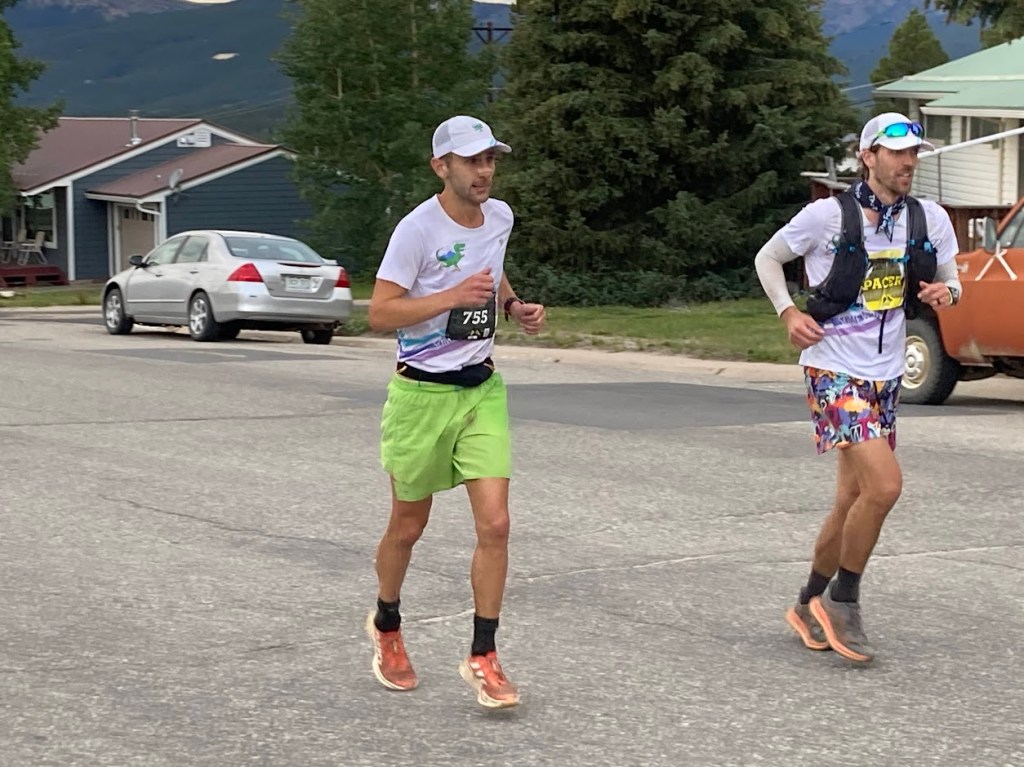
(photo: Ryan Sederquist)
David Roche broke his fueling plan into 2.5-hour chunks.
In the first hour, he consumed two Science in Sport Beta Fuel gels (40 grams of carbs each) as well as a Precision Fuel and Hydration 100mg caffeine gel, which also included 30 grams of carbohydrate. After a 30-minute fueling break, he consumed all three products again, except the Precision gel this time was without caffeine. He supplemented with a sports drink, aiming for 24-36 ounces of fluid per hour. He said there were some hours where he approached 140 grams of carbohydrates in an hour.
“I know if I can run every step of the Leadville 100 and I’m fast and I fuel well and I don’t have any unforeseen circumstances, which plague hundreds generally, then I’m going to be approaching this race unlike anyone has since Matt Carpenter himself,” Roche told Ross Tucker on “The Real Science of Sport” podcast.
That math problem was something Carpenter always knew was vital.
“He was such a dialed athlete at the time,” Roche commented of Carpenter on his ‘Some Work, All Play’ podcast a few days after his record-setting race. “He was ahead of the curve on just about everything.”
Carpenter knew the number of sips required from his Camelback to get from various on-course aid stations and check points. During his 2005 Leadville, Carpenter ingested Gatorade Endurance Formula and Carb-boom! energy gels right at the prescribed ceiling of 75 grams of carbohydrates and 300 calories an hour.
“At the time, I had researched that was around the limit a runner could absorb at a high intensity level,” he explained.

In addition to the carbs (and 24-36 ounces of electrolyte-infused sports drinks each hour) Roche consumed a total of 1400 milligrams of caffeine — the equivalent of 18, 8.4-ounce cans of Red Bull — over the course of his day.
“As soon as I started to get farther away from the caffeine gel, the thoughts that slipped into my head were like, ‘why, why am I doing this right now?’” he reflected on his podcast after the race. “I think it’s important for fatigue resistance but what I did was a risk that could have ended my race just as easily as it led to a breakthrough.”
Carpenter, on the other hand, never used caffeine in any competition.
“This is because in my day, caffeine was a banned substance according to the WADA (World Anti-Doping Agency) and its use was prohibited in competition,” he explained. “Even out of competition I seldom, if ever, had caffeine. Although I will admit, while I owned the custard shop, I did go for the occasional root beer float! But I was no longer racing.”
Roche employed a few other study-based hacks. He regularly took post-exercise ketones to improve red blood cell production and recovery, hopped in the hot tub a few times a week to enhance hemoglobin mass and calculated his caffeine genotype and his aerobic threshold heart rate, the latter of which he used on-course to know where he could speed up.
While the tools of the trade have changed, both Carpenter and Roche adopted similar speed-based training philosophies and courageous approaches to the 100-mile distance. They also bravely implemented the unconventional ultra approach of running every step of the Leadville course.
Carpenter originally ‘caught the Leadville bug’ pacing a friend in 1990, but put off attempting the distance himself because he originally thought training for it would slow him down.
“I now believe that is bunk!” he wrote in his magnum opus on the 2005 race, a redemptive run after going out at record pace in 2004 — only to humbly walk in the final 30 miles. “Instead, I think it is the way people train for them that makes them slow.”
Carpenter put in two quality speed sessions a week and targeted the U.S. 10K Trail Running Championships in Vail two months before his second — and only other — Leadville 100 attempt.
“The only way I could pull that off was to run fast,” he stated.
Roche also believed raising his long-distance potential floor required pure speed development. He regularly incorporated strides and 400-meter track repeats — ripping off 12 at 63-66 seconds a pop in his hometown of Boulder — in advance of his 100-mile debut. On ‘just’ 65-70 weekly miles — plus a hard Zwift session on the bike — he achieved his goal of increasing his threshold velocity.
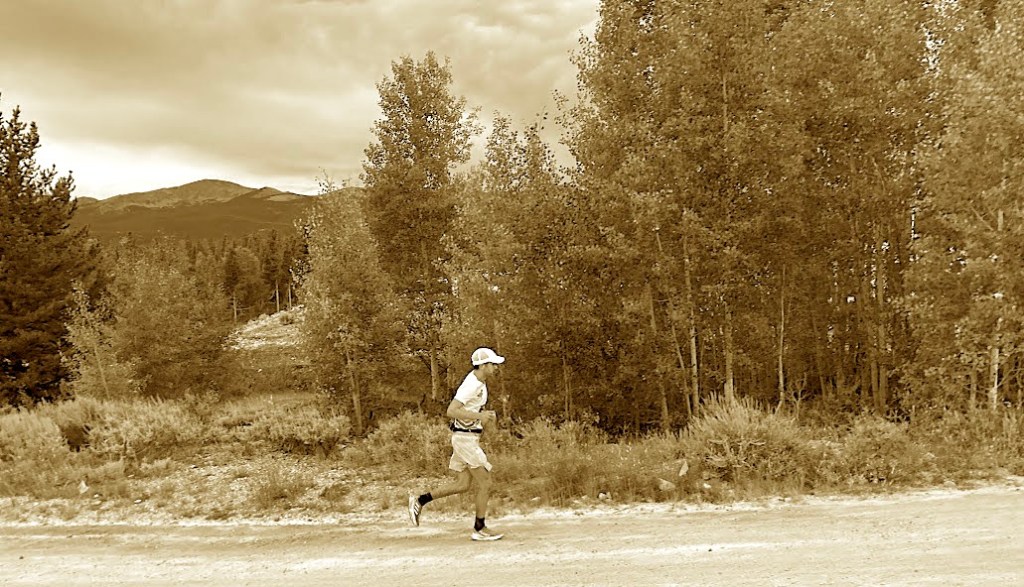
“I knew, physiologically, that I could hold zone 2 to high-zone 2 and even some low-zone 3 for all day,” said Roche. “As long as I fueled enough.”
Reflecting on that component, Carpenter said he feels “validated” by Roche’s record.
“It shows I was correct in putting so much emphasis on the fuel side,” he said. “As such, I am honored that David saw what I did and felt that I was ‘ahead of my time.’”
Reaching the limit
While examining the differences between Roche and Carpenter is a fun analytical and historical exercise, their similarities provide the most transcendent takeaways for mere mortals. Starting with their stories. Both patiently chiseled out running hall-of-fame-worthy busts from relative obscurity through intelligent hard work and dedication.
For all that’s been said about his genetic engine, it’s worth noting that Carpenter got his start in the sport as a junior in high school after misunderstanding an announcement for the cross-country team’s signups. He thought ‘cross-country’ meant a club which literally crossed the country — and he figured that would get him out of school quite a bit. His annual progression — laid out in detail on his website skyrunner.com — provides evidence of his gradual growth in the sport. My website has referenced his all-in investment on getting better, pointing to Vail Trail stories from long ago which discuss his race-specific training and tools, like a $10,000 treadmill capable of powering 5-minute miles at 23% incline.
Even with all the noted technological advancements at his disposal, it’s not as if Roche is some average joe who woke up one day and decided to stuff his face with super-caffeinated, carbohydrate-laced gels and pogo-stick on carbon shoes to a 100-mile course record. He’s been laying physiological bricks ever since he gave up his gridiron goals half a lifetime ago. Recalling the DNF in his first Leadville race — one which was a fourth of the distance of the 100 — he was justifiably overwhelmed when he reached Twin Lakes on record pace last month.
“I felt so good. And, I don’t know exactly why, but I do remember thinking at that one moment that former football player that has anxiety and never really thought he was capable of it,” Roche recalled.
“…And what I learned in that race was not about training theory. What I learned after that is that yes, I was enough all along as an athlete, too, not just as a person.”
In other words, both runners have come a long way. Roche believes it’s only the beginning.
“(The record is) going down in five years, if not by me, then by somebody,” he said on his podcast.
I agree. Further, I don’t view his performance as being an athletic anomaly — as amazing as it was — as much as a turning point in trail running history. More than the time itself, it’s what went into it that will be remembered. Tucker concurs, saying, “A decade or two from now, we’ll maybe look back at this as the era of most rapid learning. People (will) look back at 2024 David Roche as the point at which ultra-marathoning really accelerated.”
When Carpenter confirmed he’d lost his 19-year-old Leadville 100 record, he simultaneously thought “cool and bummer.”
“Look, I don’t buy so much that ‘records are meant to be broken’ as much as I believe ‘records are tracked so they can be broken.’ Meaning, when I break a record, I don’t set it hoping it will get broken,” Carpenter stated. “At the same time, I have been very consistent over the decades saying all records, including mine, get broken. I never bought into the “impossible record” hype that some have put on some of mine – especially Leadville.”
Considering Carpenter ran Leadville in the twilight of his career as a sort of ‘swan song’ (a composition which floated through a few extra DS al Codas until the his actual final race — a 12th Pikes Peak Marathon win in 2011) I was curious if he thought he left some meat on the bone, too.
“While I ate a lot, I know I left quite a bit on the table,” Carpenter said of his 2005 Leadville 100, where he was one-minute slower through 23.5 miles than his 2004 debut. “I stayed well within myself and didn’t have any issues. Further, I was running scared because of the disaster that was 2004.”
Carpenter called 2005 — where he lowered the previous record by more than 90 minutes and won by three hours — “a lonely affair” that “didn’t feel like a race.”
“There was not a lot of incentive to really go for it because the risk/reward ratio was too high,” he said before opening a small window into his admirably compulsive, intrinsically-motivated competitive streak: “Another disaster would have meant I would have to do it again.”
Having accomplished what he set out to do, Carpenter said he “saw no point in going back” to lower his own record.
“Had it been broken a few years later, I almost certainly would have gone back,” he added before pivoting.
“….for me, a more interesting question is what could I have run had I run it 10 years earlier?”
Carpenter was 41 in 2005. A couple years prior, he’d run the ascent portion of the Pikes Peak Marathon in 2:14:42, practically a recovery run for his 1993 self. The fitness was different. Still, playing time-machine is ultimately a tantalizing — and “pointless process” — in Carpenter’s mind.
“I don’t have any regrets,” he said. “Bottom line, as they say, “If ‘if’s and but’s were candy and nuts what a wonderful world it would be!’ I ran what I ran, and David has beaten that — good on him.”
To his credit, Roche has humbly acknowledged he stands on the shoulders of giants in all of his media appearances.
“I am fortunate to be able to ride a performance wave that everyone gets to ride to a certain extent,” Roche told journalist Brian Metzler. “I think the rising tide raises all boats, and I was just lucky to be the boat that caught this wave.”
Even though he belonged to a different era, Carpenter probably won’t ever go Kevin Garnett on the bit — creating viral Instagram clips ranting over the current crop of stars incessantly falling short of the standard set in his glory days. In fact, Carpenter intentionally avoids interviews out of a desire to avoid stealing any limelight from today’s runners.
“It’s not my time and I don’t want to interfere with the limited bandwidth that should go to the current athletes,” he said. “David had an amazing race. Congratulations to him.”
On the one hand, Carpenter isn’t a curmudgeon. On the other, he’s too straightforward to effectively spout cliches.
“Yes, another of my records is gone and eventually they will all be gone. However, progress in the sport is important and healthy,” he starts before revealing the still-coiled competitiveness hard-wired into his veins, unable to resist popping through his skin from time to time:
“I just wish we had time machines so that athletes from different eras could go head to head. It would be awesome to see how far we could push each other.”
Sometimes I wonder if Carpenter could make a run at some records — even now. A few days after our correspondence, his daily running streak hit 12 years. I wrote five questions for him for this story. He replied with a detailed 3,799-word email.
“I added my signature at the end, because that was just too close to 3,800,” he wrote, his energy magically bleeding through the basic Arial font.

I mulled over his answers, and his legacy, while conducting a classic Carpenter workout — running up Vail Mountain and taking the gondola down to save the joints. Preparing for my first Pikes Peak Ascent, I’m ready to embody Roche’s “shoot your shot” mindset and I’ve adopted Matt’s ‘signature’ as my own secret self-talk:
“Go out hard. When it hurts, speed up.”
Matt Carpenter
It’s a good modus operandi, especially for those — like Carpenter — who seemed destined to push themselves each day, just a little. I think — no, I hope — I am the same.
I hope one day — when I’m far away from meets and medals are rusted over; when races and yes, (if I’m lucky) records, are a distant memory — the internal pull to find my limit will still tug at my heart and tighten my shoe laces.
“My running is my own now,” Carpenter hid in his email.
“And I like it that way.”

For more Matt Carpenter stories, stats and other fun things, visit his website. Consider yourself warned: you will be tempted to spend the rest of the day scrolling and reading!

 Seder-Skier.com
Leave a reply to The Weekly Wax: Sept. 24 – Seder-Skier.com Cancel reply