
A recurring bit played out by a Midwest major-market radio host I listen to centers around the “idolization and pedestalization” of pro athletes who think the universe revolves around them. Over the last couple years, I’ve observed this phenomena up close in Colorado with the ever-expanding egos of Deion Sanders and his CU Buff entourage.
It was announced Monday that Sanders’ son, Shedeur, and his Heisman-winning teammate, Travis Hunter — both of whom were part of the mass exodus of athletes who followed Prime from Jackson State University to Boulder two years ago — will have their numbers retired after leading the Buffs to (and I’m not making this up) a 4-8 season in 2023 and a 9-4 mark in 2024. In the program’s 135-year history, only four numbers have been retired: Byron White (1936-37), Joe Romig (1959-61), Bobby Anderson (1967-69) and the late Rashaan Salaam (1993-94). Interestingly, no athlete from the school’s only national-title-winning season (1990) have their numbers hanging in any rafters.
If you can’t tell, yet, let me be clear: I think this is preposterous. Apparently, I’m not alone.
One tweet I read highlighting its absurdity pointed out the fact that Tim Tebow — a two-time national champion and the first sophomore in NCAA history to win the Heisman — doesn’t even have his number retired at the University of Florida. You could argue Tebow is one of the top-5 college football players to ever live!
But arguments over merit aren’t the only reason I’m hammering away on my keyboard right now. After all, Travis Hunter is ridiculously talented and Shedeur Sanders is really good at getting NIL deals. Alas, I think these jersey retirements highlight two larger issues: the ‘my-kid-deserves-a-state-title-trophy-too’ movement AND the increasing narcissism brought on by sports’ marriage with the constant drone of social media updates.
In other words, society has devalued certain sporting accomplishments — from making it to state to making All-American to, apparently, having your (or your offspring’s) jersey retired — and simultaneously cultivated a climate of ‘look at me’ through flashy Instagram reels, college commitments and up-to-the-minute updates on who just entered the transfer portal.
The result is 1) tired sports reporters who can’t keep up with all of the mom’s who tell them that ‘their kid made it to ‘worlds’ (which, turns out is actually the “Kwik Trip USA Junior Club AAA State Middle School Wrestling “Bantam ‘B’ — 11-12-year-olds — North American FIFA Tee-Ball Training Wheels Wrestling Nationals 2.0 Presented BY STIFEL Americas Tour nationals worlds nationals”), TOO…. 2) kids who think their hot s$%#, and most importantly, 3) the loss of transcendent takeaways in sports.
Hoosiers, Halls and the Heroes (of our own stories)
I think one of the coolest sports stories in all of human history (not an exaggeration) is portrayed in the movie “Hoosiers.” In 1954, the Milan High School boys basketball team won the hallowed Indiana state basketball tournament — back when there was only one class. Milan’s enrollemnt was only 161 when the rural school beat Muncie Central High School 32-30 in the championship game.
One element portrayed in “Hoosiers” which resonates with me is the exciting investment the whole town makes in the journey. Caravans of fans criss-cross the countryside to every game as momentum grows from the 19-2 regular season right up to the final game in Butler Fieldhouse. Unlike today’s state tournaments (where 34 of Class AAAAAAAAA’s 45 teams qualify for ‘state’ via RPI), Milan’s road to Indianapolis was arduous. They had to win three sectional games and two regional games just to make it to ‘semi‘ state. Their reward for claiming both ‘semi state’ contests was a trip to the big city for the final four.
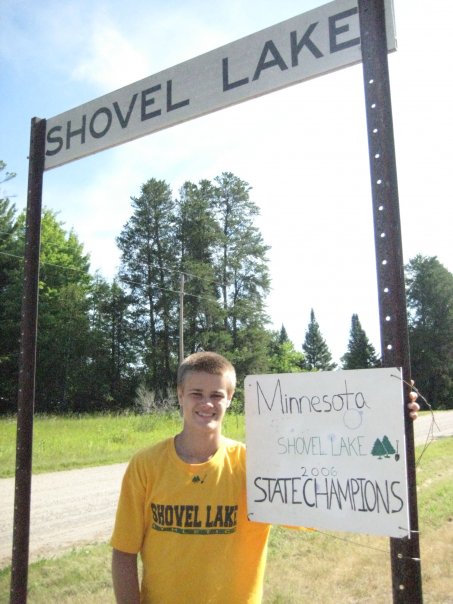
Enamored by tournament thrills and chills, my brother and I decided one family vacation to pass time in the car ride from Moorhead, Minnesota to the Grand Canyon by organizing every township, town and city (and maybe a random lake or two) into a gigantic, 1600-plus-team ‘Minnesota State Tournament.’ We used two playing card suits to represent a 7-game series, playing off each team and every round with a randomized shuffle, flip and repeat system until — 2 years later — we arrived at the State Tournament. The final 87 squads (*the winner of every county in the state) played off until we crowned our first state champion, Shovel Lake. The Aitkin County post lives on as the name of a fictional radio station which airs the world-famous Seder-Skier Podcast.
We made shirts. We hung up a wooden sign in the abandoned Soo-Line stop that is Shovel Lake. It was epic.

I set this stage because one of the things my brother and I would always do before two teams faced each other was make up some Hickory High story about how the whole town was in attendance or the starting five was actually five siblings. Whenever a team lost, we’d always say, “Well Bob, there’s always next year.”
It was humorous because 1) it was made up and 2) the chances of Tom and I replicating this gargantuan enterprise seemed preposterous at the time. It also worked because stakes and storylines stick. When there’s a one-in-1600 chance you are going to win, the most likely outcome is that you don’t. Spoiler alert: society has lost that.
Crazy enough, I actually took it upon myself to organize the tournament on THREE more occasions. I played them off alone on team bus rides through high school. As you could have predicted, some small towns never made it past the first round.
“Well Bob,” I would still say to myself, since my brother had graduated high school and moved on to other more important things like having a social life, “…there’s always next year.”
As I gazed out the window of the bus carrying my Moorhead High basketball team (a real team that I was on) back from Bemidji to the cornfields after one late-night road game, a part of me wondered if my career — which I cared so much about and had invested so many hours into — was going to end like that. Without any spectacle. Without banners and confetti or even, heaven forbid, a nice social media post. Without jersey retirements. Maybe even without any real acknowledgement at all.
As we drove past the turn to a small town, Bagley, where my dad grew up, I imagined backyard baseball games I wasn’t even alive for between him and his neighborhood friends. I thought of the high school version of my dad going on a training run down the country roads when. Flashbacks flew onto the windowpane of me shooting hoops in the driveway as 9 or 10-year-old, dreaming of becoming the next Bobby Plump.
I was about that age when I found myself sitting at a fancy dinner with my grandparents and parents and brothers and an aunt and uncle. It was the Moorhead State University Hall of Fame banquet. My dad, who held a few track records at the time, was being inducted. Other inductees got up and gave short, lifeless, forgettable speeches.
Then my dad stepped up to the podium.
While I don’t recall any of the exact words or phrases or even anecdotal stories he shared, I do vividly remember being more moved listening to this speech than I ever have with any other commencement or acceptance speech. I don’t think it had everything to do with it being delivered by my dad, either. It was more to do with how his message felt thickly laced with what I’m really trying to convey in this column.
Here was a guy who’d come from a small town and truly developed into something over the course of five years. He physically and mentally matured into a stellar athlete, school record holder, captain, MVP and multi-time All-American (back when it was hard, of course). But the accolades themselves weren’t central, per se …Rather, they were the means by which all the really important stuff came to life. After all, he’s a much better dad than he ever was as an athlete, but I’ll bet him being an athlete had something to do with that, too.
My dad’s discipline, belief, toughness, competitiveness and all-around pursuit of excellence were honed in the NAIA track and cross-country sphere because of the fact that he actually cared a lot about trying to win races, set records, and yes, I suppose, someday, have his face put on a plaque and placed behind a glass window. Caring a lot was necessary because all of those things were actually hard to do. You could say in one sense he learned what it actually means to care, period, while accounting for the attached risks and stakes — particularly in a world where failure is a very real possibility.
It’s no wonder then, that a hallmark of today’s generation is apathy. No one cares much about anything, because no one really ever ‘loses.’ Downstream, flexing the muscle required to show up on time for Saturday morning practice is sort of the same muscle you use to show up for your kids’ dance recital. Making yourself do another set of pullups is not unlike making yourself discipline your son when you really don’t feel like it.
These days, people tend to say we’re too focused on winning at all costs. In a sense, they’re right, especially when its manifested in the out-of-control parent swearing from the bleachers at the lacrosse ref during a mid-season game against too bad teams… But are we throwing the baby out with the bathwater (at least, I think I used that metaphor correctly….)?
You see, I don’t take issue with people caring about wins and losses or having jerseys retired. I don’t take issue with athletes or teams making it to state, nationals or worlds, either. That’s not the problem. In fact, those things are the very real and necessary ingredients we (perhaps arbitrarily) place into the arena so that much more valuable skills, attributes and lessons can come forth. That’s why they have to be preserved. That’s why I’m so troubled by our current culture.
People preach how we need to ‘not make everything about winning/awards/records/etc,’ only to turn around and essentially legislate every athlete into a state tournament experience — and make sure every social media post and small town newspaper reporter covers it. In doing so …in trying to give every kid the Milan experience…. they’ve destroyed what made Milan magical in the first place. In making ‘state’ increasingly accessible for everyone, you’ve ripped out the most valuable part of the whole thing: not making it at all. Ever.
As that wise Midwest radio show host also often says: “get to the Western Conference Finals and get back to me.” In other words, do something actually worth talking about. (Warning: you might not actually be able to!)
It’s ironic: I sort of became the obscure, middling town in my own fake tournament. Not only did I never make it to the Western Conference Finals, I never got remotely close. In fact, I never made it out of a section tournament in basketball. I also I never ran in a state meet. In fact, the only ‘state’ competition I ever competed in was the state true team track meet — and I did so in the high jump, long jump and triple jump! (I didn’t do very well in case you were wondering….). In college, my ‘claim to fame’ was that I also was in the band…I guess I snagged two All-Conference honorable mentions, and those meant a lot, only to me, because of the work I did to get there.
After my last college race, I went out to the finish line, crouched on the ground and closed my eyes. I tried to have ‘a moment.’ Modern millennials would have planned a drone shot or made a teammate shoot an iPhone video I could later make into a reel … (“Well, didn’t think it would end like this/was hoping for more/running, it’s been a ride, you’ve given me so much … blah blah…hanging up the spikes for good…blah blah”….seriously, no one cares….).
Despite my authentic attempts to get emotional, I couldn’t shed a tear.
But wait! What about that amazing speech my dad gave! What about the value of a college athletic career!!!! Where was my great victory? My emotional epiphany? I’d done everything he’d done — probably more from a sheer workout/sacrifice standpoint. Didn’t I deserve what he got? Why wasn’t he stepping in like Deion and retiring my Cobber uniform for me!!!!
“Well Bob,” some voice was whispering in my ear. “There’s always next year.”
Immediate introspection and meditation on this truth forced me into a position of quick perspective acquisition and dramatic philosophical grounding. There was no ‘next year’ in the jersey I was currently wearing, but somehow I knew there had to be more to this investment than what I’d experienced up to that point. I pulled myself off the grass, glanced at the ‘NCAA’ logo and walked away. I had no choice. I had to keep striving.
And I was right.
I kept running, I kept going, I kept learning and I kept growing….and I’m a different person because of it. In other words: sports has now served a much richer purpose for me than any championship, record or jersey retirement ceremony could have ever accomplished.
On a recent ski — a sport I probably wouldn’t even have taken up if the above stories hadn’t transpired as they did — I flipped on my radio show. Our favorite flyover country host was talking about how the baseball hall of fame has too many people in it. The heart beat of his argument predictably resonated with me. It also sort of striked against the other point he likes to make, the one I mentioned at the opening of this diatribe.
On the one hand, if we only retire the numbers of a few truly great athletes, we perpetuate the “idolization and pedastelization” problem. Those individuals actually become idols. But if we let everyone in, it means nothing and the tires of transcendent values lose traction.
I tend to think such individual deification is a small cost to society compared to extending the halls of Canton all the way to Ransack Junction, which, I will remind you, almost won the Toyota USA Junior Club AAA Division 2B sub-ultra world championship in the 11-12-year-old tee-ball tournament of the century (Presented by Stifel) last month, thanks to Braxton McBraxton’s all-league performance…he went 2-for-3 from the plate and had a double, (or so I’ve been told by Braxton’s mom, Karen, via email last week, but will have to verify on the up-to-the-minute boxscores provided for every little league game on the GameChanger App….I’m not making that part up.).
I say we keep the halls of fame and the jersey retirement ceremonies. But, let’s make sure they mean something. After all, those are the carrots we strive for. Yes, for the Christian they’re ultimately meaningless in light of eternity, but they get us out the door on icy January mornings. They get us through the third lap or the fourth rep. They help us put aside our jealousy and emerge as an unselfish teammate or an unsung hero. They make us practice. They cause us to grow. They sweeten the buzzer beater and more importantly, provide depth to the heartbreaking loss.
Yes, in the end, only a select few are lucky enough to actually get their numbers retired.
And the rest of us are even more lucky.


 Seder-Skier.com
Leave a comment