
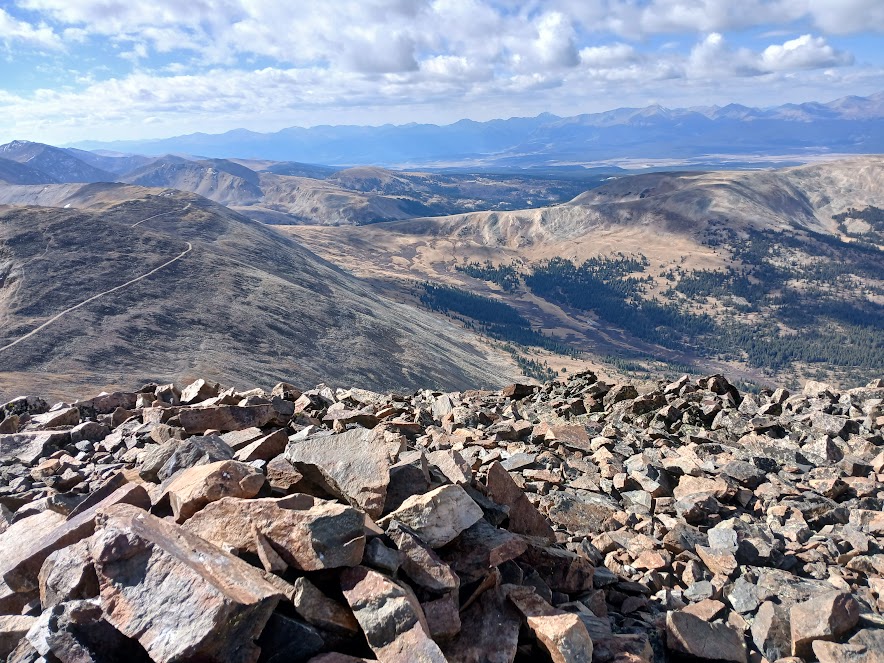
As long as there is dirt, I’m going to keep running up mountains!
The snow held off for another week — well, sort of (more on that in a minute) — which meant I was able to run three mountains in a four-day stretch. You may recall, there was talk of me jettisoning off to Park City for the week to do some training and talking to U.S. Ski Team members. Even though my wife gave me the green light, I just couldn’t bring myself to be that selfish. Besides, why drive 7.5 hours when I can go to the new Park City – Buena Vista?
Then, I decided to just be lazy and stay in Leadville.
So, here is what the training log has looked like during our SederSkier Fall Camp:
- Oct. 14 – AM – Run up Mosquito Peak (34 min. uphill threshold, Mosquito Pass); roughly 2 hours running/ PM – 90 min gravel ride
- Oct. 15 – AM – Mt. Massive ascent FKT attempt – with w.u. and c.d. = 15 miles/ PM – 90 min. road bike
- Oct. 16 – AM – 75 min recovery run at Turquoise Lake/ PM – 75 min DP/ercolina trainer
- Oct. 17 – AM – Mt. Harvard fail…11 miles total; turned around because of snow/ PM – 2 hr DP in Buena Vista
- Oct. 18 – AM – 80 trail run at CMC + 1 hr 40 DP (with 25 minute break/bike ride with Novi around the church parking lot in between)/ PM – 60 trail run at Turquoise Lake
- ***two days prior to my Mosquito Peak run was a 13×400 session on the Mineral Belt!
Mosquito Peak exploration
The main impetus for running this route on Monday was to explore the mining road extending north from the top of Mosquito Pass. I wasn’t really sure how long it would go, and/or if it could eventually take me all the way down to Highway 91. Plus, I wanted to take another crack at Mosquito Pass, which is a tough, 3.1-mile, 1,959-foot (11.9% average grade) climb. It starts out with a gradual, but chunky incline and gets progressively harder as you ascend.
I approached it conservatively, hoping to not stop the whole way. After about 27 minutes, I took 10 power steps, then found my running cadence again. I ended up getting to the top in 34:30, which is the fourth-best time for the segment. It’s just 9 seconds behind Seth DeMoor, who ran 34:21 in his winning effort at the Leadville Heavy Half.
It was also 27 seconds faster than current L100 record-holder David Roche‘s time from 10 years ago, and, perhaps most impressively, 30 seconds up on Tyler Andrews, the world’s best FKT artist. Now, I’m not suggesting I’m better than any of those three runners because of this effort (particularly Andrews, who is an absolute monster….), but it is helpful in at least providing some level of context (plus, runners are notorious for using the transitive property to boost ego whenever possible….and I am not immune to doing it either…).
After switching into my jacket, turning up my Canon+ audio book, and taking a sip of water, I slowly jogged towards Kuss and Mosquito Peaks.
***just a side note on nutrition…all of the workouts mentioned here were done fasted, with my last meal being consumed roughly 13 hours prior. I packed 20 oz of Emergen-C in one waterbottle and 12 oz of regular water in a separate bottle, both of which Ajee carried. She also had a Gu, my Epi-pen, extra gloves, and a couple slices of bread wrapped in a plastic bag….I am yet to break into the food stash. At the turnaround of most of these runs, I’ve taken sips of the Emergen C, sometimes finishing the entire bottle before the finish. If, as you’re reading this, you think I’m a crazy person, feel free to join the growing club over there >>>>
After a brief, gradual climb, I reached the road I’d been looking forward to running — a mostly flat ledge perched at 13,100 feet. My self-talk smoothly spoke into the silent mountain mist: “this is definition of skyrunning.”

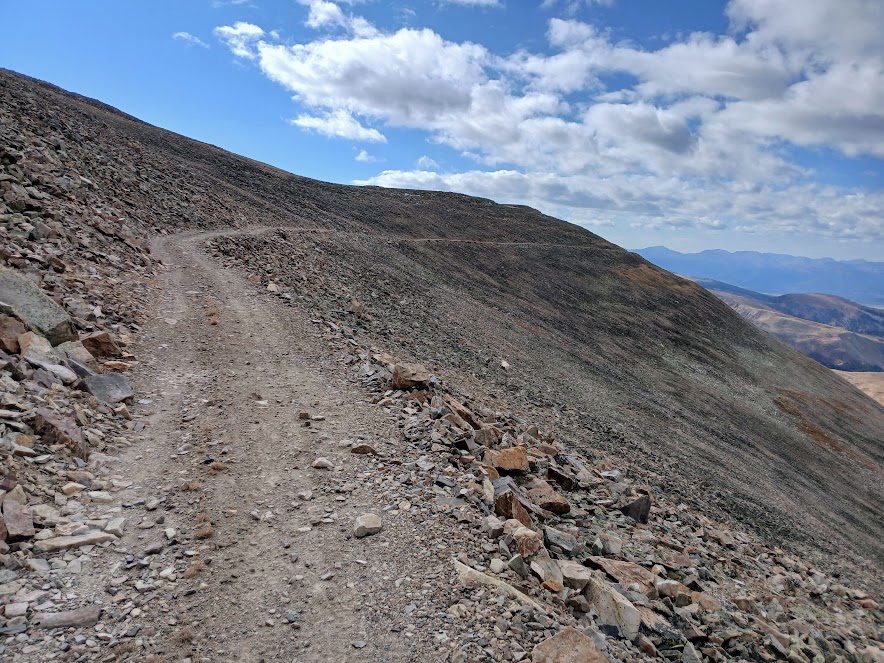
Looking back towards Leadville
It really felt like I was running in the clouds!
That joyous section was over too soon, however, as the road curved past some old equipment and called me upwards. I found a scramble scree of a singletrack, which I followed to the top of Mosquito Peak, elev. 13,787 feet.

I decided it would be unwise to venture down the unofficial switchbacks (see below), which looked as though they might go down to Highway 91. I didn’t have guru Karl with me…and didn’t want to get lost in the woods.
Speaking of Karl… legend has it that the car pictured below was actually the first car he ever owned when he moved from the East coast to the Cloud City in 1965. Legend has it that he scheduled a ski team practice on the ridge of Mosquito Pass one October afternoon. When a blizzard moved in, folks packed up and drove back, but Karl’s car wouldn’t start. Being the generous fella that he is, he’d loaned out his skis to an athlete…so all that he had in his broken down vehicle was an old 10-speed bike.
Legend has it that Karl — who might be 95 years old but only looks like he’s 22 — took the bike out of the back, blew up the tires with his mouth, and proceeded to ride all the way back to Leadville. Legend has it that he’s never trusted a car ever again, which is why today you’ll see him ride that same old trusty bike everywhere he goes, rain or shine; snow or ice.

That afternoon, I hopped on the ol’ road bike myself and put in a 90-minute session, just to get the legs all tired for the next day.
Originally, my Tuesday plan was to head south for a Chaffee County 14er like Mt. Harvard. But, I had work to complete, and after letting my wife get out for her run, it was a bit too late for that. So, I decided I’d get in my car and just drive to Mt. Massive. I tentatively was aiming to run up as fast as I could, but I definitely hadn’t committed to that project, at least not deep in my soul.
My mood shifted when confronted with construction on a short stretch of Halfmoon Road. Instead of making a reasonable detour around the 100-meter section in question, Leadville, in its infinite wisdom (yes, I’m blaming the entire town, because this is SOOO Leadville), sent people halfway to Alamosa before rerouting them through an obscure forest road, which came out on the other side of said stretch, which I — and with Dave Barry as my witness, I’m not even making this up — could literally throw a football across.
Here is a photo of the construction site location:
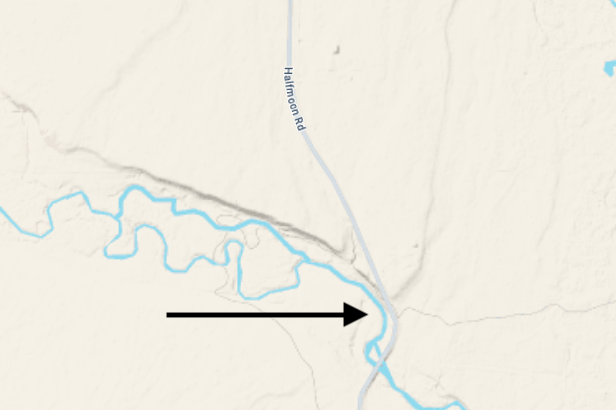
…and the detour…

After driving like a reckless mad-man through old forest roads, I arrived at the trailhead. My car was the only one at the Mt. Massive lot (there were a dozen in the Mt.Elbert lot a half-mile down….I guess even 145-mile detours don’t deter people from hiking the state’s tallest peak….). I changed, stretched and ran a one-mile warm-up before lacing up the Hoka Zinals.
Go time.
I broke up the ascent this way: 1) run hard during the initial 9-minute opening climb, 2) go as fast as possible along the ensuing 2-mile flat section, 3) find a nice rhythm and run for as long as possible after that..at least above treeline…4) survive the chunky middle section…keep moving, even if it’s walking….5) assess at the ridge (roughly 13,900 feet). If I’m under 1:10, bolt on up to the summit…if not, maybe break and come down or just ‘chill’ up to the summit.
Everything went according to plan.
The legs felt great on the opening uphill punch, and when I hit the flatter section, I opened up. 10:26 for the first mile, 7:37 for the second and 9:11 for the third. I set the KOM on the ‘trailhead to treeline’ section (36:46). In fact, at that point (4.0 miles in, 1,729 feet of climb), I was 43 seconds ahead of DeMoor, 58 seconds clear of Sage Canaday’s pace and 4 minutes and 23 seconds ahead of fellow Leadville runner Noah Williams, a Team USA trail member.
I started power hiking for the first time about 400 meters after this section. Looking back, I know that I walked some spots where I shouldn’t have over the next 1.5 miles. Some of it was getting out of rhythm, some of it was loose/chunky terrain and some of it was just a lack of fitness.
I didn’t stop, though, and reached the ridge in almost exactly 1:10. I squirted off the trail to the left, just to make sure I notched that segment (completely pointless, I know, but for some reason, in my oxygen-depraved state, it made sense. I probably lost a few seconds doing so, but didn’t care at the time). Then I thought, “should I go to the top? How do I get to the top? Have I been to the top?” all at once….After roughly 8-10 seconds of deliberating, I bolted for the top.
One boulder in, I decided I needed to dump Ajee’s shock remote, which I’d been holding in my hand the entire way. I chucked it on a rock, then changed my mind. Even though I’d seen no one the entire way, I didn’t want to risk someone coming down seeing it and grabbing it. I reached for Ajee, opened her pack and shoved the remote inside.
The whole escapade probably only cost me 5-10 seconds. Other than that — the largest loss of time came when I accidentally lost track of the trail halfway up. I ended up going on the west side of the ridge, scrambling up and over a stupid rock section instead of just going around it. I really don’t know what that cost me, but it definitely could have been 30-60 seconds. Nothing I could do – I hadn’t been by this (I ran up Mt. Massive two years ago…but in summiting it this time, I realized that I really had only made it to one of the ‘false summits.’ There’s at least three.).
Feeling totally fresh and motivated, I sprinted whenever I could; unfortunately, shale prevented me from doing so very often.
Long story longer – I wound up at the top in 1 hour, 21 minutes and 8 seconds. Out of 1,146 attempts on Strava – by 958 individuals – my climb of the 6.61-mile, 5,004-foot trail is the second-best by a mere 53 seconds.
Reflections:
- This felt redemptive. After my disappointing Pikes Peak Ascent (PPA) performance, part of me definitely doubted whether or not I belonged in the upper echelon of uphill running. Considering DeMoor is a two-time winner in the full-marathon, and has a PPA PB of 2:06.44 (he ran 2:09:47 in 2023, the year he ran the Mt. Massive FKT), being that close in an effort that is roughly 75% of the PPA distance is encouraging. I’ve learned you can’t really extrapolate any one mountain onto another, but this run offered a reasonable basis for optimism. (***Sage Canaday won the Pikes Peak Ascent in 2014 in 2:10:03. He also finished second in the full marathon in 2019, one year before his Mt. Massive Strava segment, which was the FKT until DeMoor broke it).
- No one cares about this run and that’s probably a good thing. I was somewhat shocked that my Strava upload garnered just one ‘like.’ I swear, the internet is against me! In fact, more people liked my downhill segment, which was a slow, don’t-roll-your-ankle cool down (why did I break them into two segments, you ask? I don’t know…..). I’m done feeling sorry for myself about the lack of praise, though. For one, it’s just a workout. Second, I really care about doing something at the PPA in 2025. This is a good step, but as far as that race is concerned, I’ve done nothing yet. Need to stay hungry, need to stay healthy, need to keep grinding…..
- Why did I feel even remotely good on this run? This is perhaps the more confusing feature of the day….From a volume standpoint, the three weeks leading into this totaled 23 hours, 23 hours, 21 hours of volume (including a Pikes Peak Ascent and Cougar Ridge Classic race in there!). From Oct. 7 to the event, I had some pretty good intensity sessions, too. Consecutive uphills on Mt. Antero and Mt. Princeton, a treadmill hill climb session, 400s….and a hard session up Mosquito with a PM bike to boot! I guess this is why I’m not always convinced of the point of even taking a taper (at least when you’re a dad…..). Some days you have it, others you don’t. If you train and rest consistently, you’re going to make consistent forward progress.
Alright….one more running entry.
Motivated by my Mt. Massive achievement, I scheduled Mt. Harvard for a few days later.
I arrived at the trailhead at 9:30 a.m. It was drizzly, but I was expecting that. The forecast called for rain between 10 and 12. I was hoping it would be light rain.
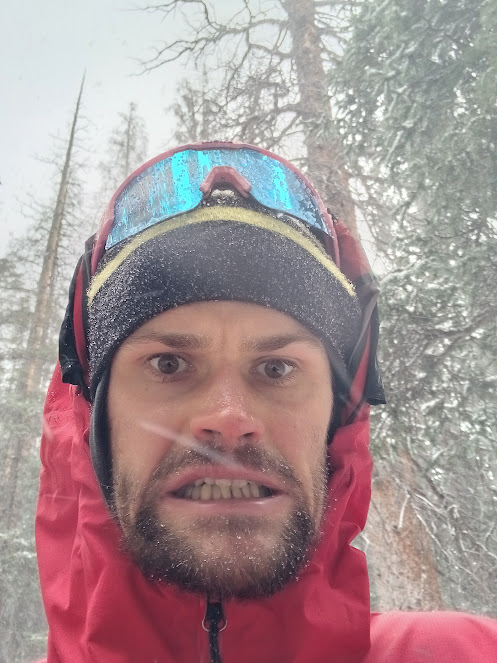

It turned out to be a blizzard with heavy snow and whipping winds.
Fortunately, I had Ajee with me, as well as an extra pair of gloves and a thicker rain jacket. Listening to a Doug Wilson sermon series the whole way up, it was actually really quite peaceful to be floating on top of the soft, white stuff. My hat enclosed my cheap ear buds, giving them a noise-dampening quality that would make Bose buds jealous. Finding my running rhythm was easy, for whatever reason.
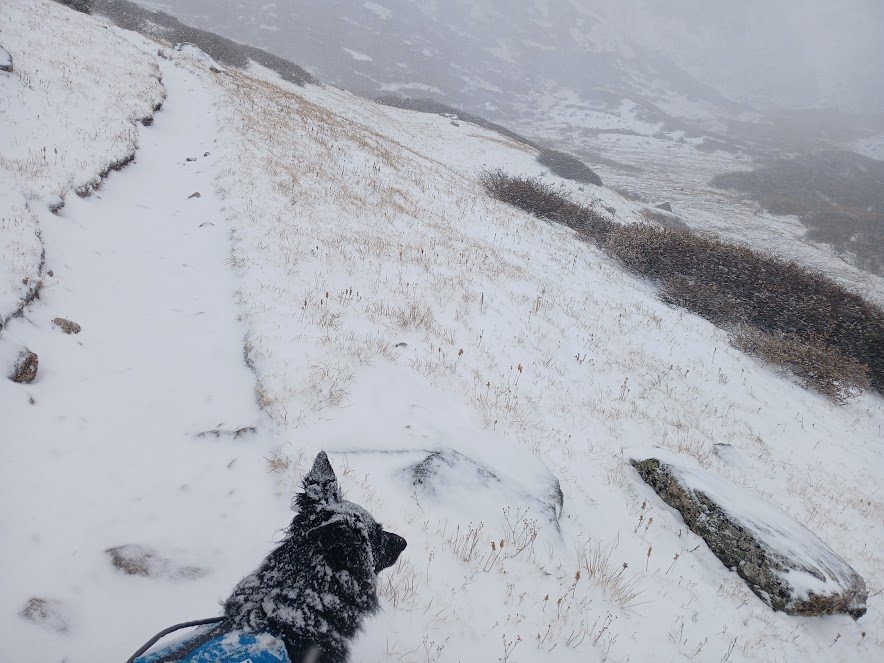
Alas, I knew I needed to be smart, and I could tell about 3 miles in that the summit was not going to happen. I pushed up to 5.5 just to make it a square 11 mile run, and that was definitely the outer limit. My tracks were covered on the descent, which was snowy all the way until the last 1.5 miles.
This mountain seems like it might be one of the more runnable trails out there, so I’m looking forward to trying it out soon. Maybe next summer.
Or…if it warms up a little….maybe next week.
Stay tuned.
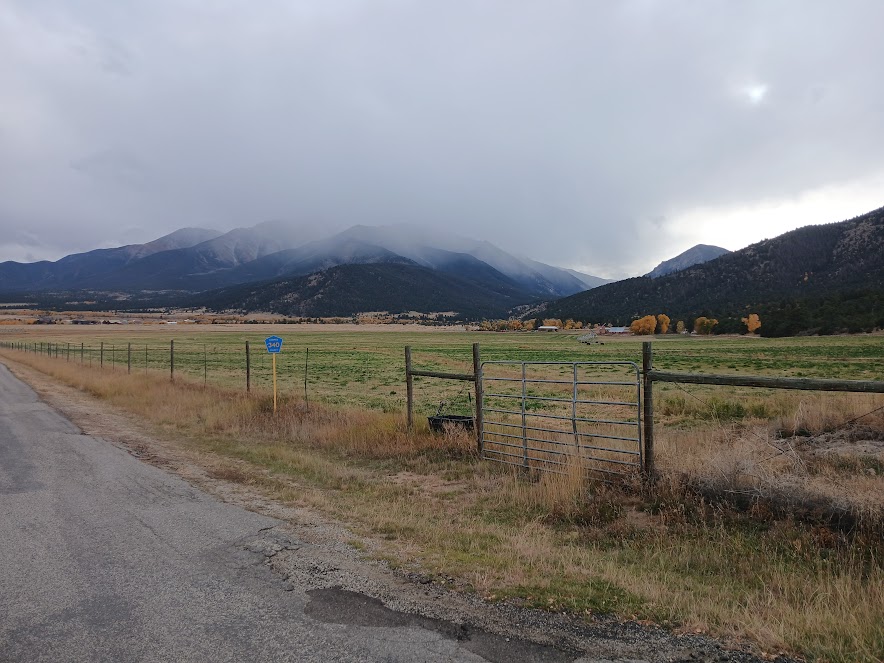
Afternoon rollerski GALLERY: ‘Farming, horses, ranches in the mountains — for my dad and twin brother to see’


 Seder-Skier.com
Leave a comment