
The week that was (for me)
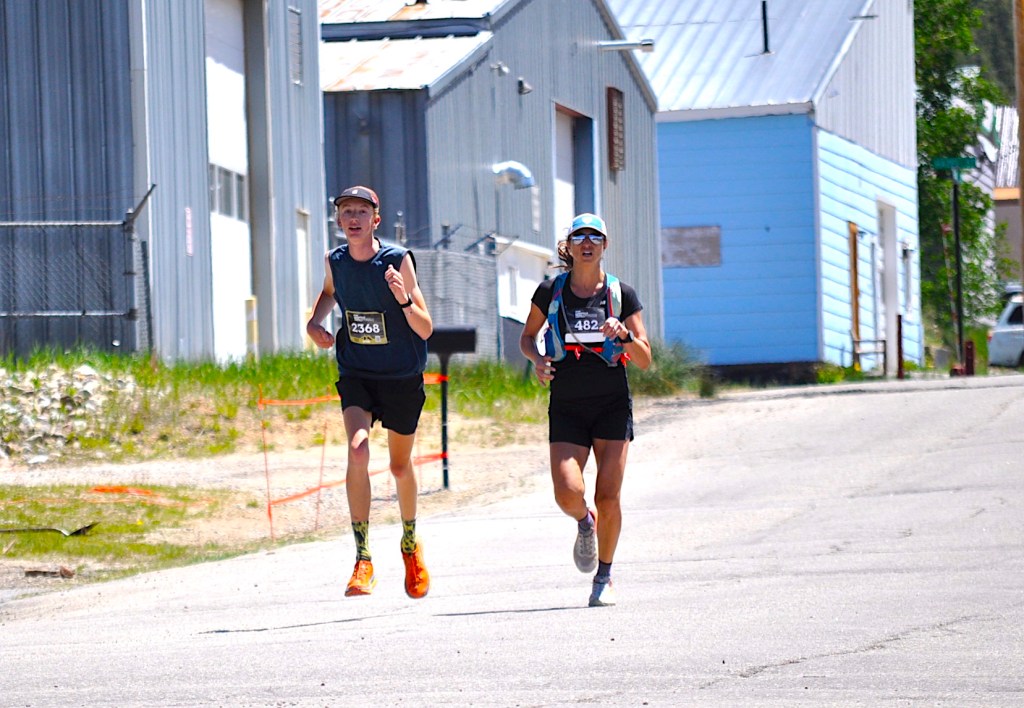

Christie’s brother, Bryan, and his family came to Leadville this week to visit for a few days. It was a treat seeing Novi and Ella enjoy playing with their cousin. We spent time around the campfire, hiking at Turquoise Lake and the Fish Hatchery and playing at various parks.
The highlights of the work week included interviewing Mika Vermeulen, watching Edwards local Val Constien win the Olympic Trials steeplechase and doing a story on a NYT bestselling author and internationally-known pianist. I also “brought the family to work” when they came to the finish line of the Leadville Heavy Half.
Training-wise, I put in a tough double on Wednesday. In the morning, I ran up Vail Mountain and took the lift down. I didn’t try to run super fast, but it’s always a challenge to just keep moving when you’re climbing a little over 2,500 feet! In the afternoon, I wanted to get some turnover while going uphill and being ‘nice’ to my joints. So, I used one of my free passes at the Avon Recreation Center and did a treadmill workout. The workout was 4 minute ‘on’ with 1 minute ‘easier.’ The On was 2-4.5% grade at 6:40 down to 6:22 pace. The off was 2.5% grade at about 7:35 pace. The last 10-15 minutes I brought it down to 2 % grade and tried to progresso the pace down to 6:10.
Afterwards, I went over to cover a Bravo! Vail performance before driving home. Full day!
The week that was in skiing
At least someone knows how to make great cross-country ski content.
Our interview with Mika Vermeulen
Lessons from the Olympic Trials
Want more Olympic Trials thoughts? Check out our podcast from July 1….
The importance of visualizing the bizarre and unfortunate. The women’s 800-meters was supposed to be a relative cakewalk for defending Olympic champion and American record-holder Athing Mu.
Even though the prodigy hadn’t raced most of the year, her immense talent allowed her to breeze through the opening two rounds. In the final, however, disaster struck. Mu, in cutting across the front, tripped up and hit the deck, never to recover. Amidst that tragedy was another: in avoiding Mu, Sage Hurta-Klecker lost critical ground and never recovered.
“I can’t even begin to describe what it felt like to go from perfectly executing my race plan to seeing my Olympic dream (literally) running away from me in the blink of an eye,” she posted on social media.
Even though Hurta-Klecker’s weird shove of Elle St. Pierre in the 1500-meter semifinals made me feel less bad for the On Athletic runner, I still do feel bad for her. I also think this entire race showcases a couple key lessons any endurance athlete should heed.
- The best way to feel comfortable racing is by racing.
- It’s important to visualize our reactions to the ugly, unlucky things that can happen in any race.
On the first point, Mu’s mistake is at least partially a product of not racing at all in the last 12 months. Whether that was due to injury or interest (or lack thereof) is hard to know for sure. Either way, if we connect this to ski racing — where shoulder-to-shoulder crowds and mass starts can invoke tremendous fear in the rarely-raced master athlete — I think it’s worth pointing out that you can’t replace actual racing for honing strategy and composure. Probably more to say about this, but we’ll stop there.
The second point is something less people are talking about, but I think it might even be more important.
These days, I often hear very high-level athletes talk about how they rely on visualization strategies before races. They image all aspects — from the warm-up to the penultimate lap — in order to, as Grant Fisher put it during his NNF talk, create familiarity in an unfamiliar setting.
While I don’t dismiss this type of visualization, I also would like to highlight the importance of visualizing the most crazy, disruptive, unfortunate thing that could happen as well. Don’t visualize yourself ‘choking’ in crunch time — that’s counter productive, no doubt. But, it’s ok to visualize a teammate having a meltdown at center court during crunch time. After all, that could happen, and if you’ve already thought through your response to his actions, you’ll be more prepared to handle that situation appropriately.
Similarly, we don’t envision losing our spike on the second lap of a 5,000-meter race, or having someone fall right in front of us in the 800. But Mu’s fall in and of itself didn’t cost Hurta-Klecker a top-3 spot. It was her reaction to it that did.
She was able to reassert herself in the pack pretty quickly, and yes, there was energy expended to do that. But, this wasn’t a 1:52 race…She was fit enough to handle the moment — even with the extra baggage. Had she visualized the scenario beforehand, and imaged herself not panicking, finding her stride/rhythm quickly, and putting the event behind her immediately, I think this would have turned out differently.
Now, that’s easier said than done — in any sport.
But, how often do we see someone not recover from something like a broken pole, a missed feed (OHHHH GOSHHHHH), inopportune slip, or a bevy of other potential excuses which so often throw athletes mentally (and consequently, physically) from a state of supreme athletic performance?
Too often, that’s how often.
The importance of patience, discipline and internal belief to successful injury rehab.
Val Constien rise from 2021 Olympic surprise to unsponsored, injured and discredited distance runner ….to Nike-sponsored runner is something I heavily documented at the Vail Daily the last couple years.
When she came back from a torn ACL to run a 9:27 steeplechase a year after surgery, I wrote about that, too.
Then there was the 9:14 at Pre, which established the Battle Mountain alumna as a legitimate Trials favorite.
Her win — in the third-fastest time every by an American…9:03 — is one of the greatest stories to come out of any Olympic Trials.
In this interview, she’s candid about the secret behind her not only coming back from an injury, but coming back better.
I know there’s more to be said, but that’s all the time I have this week. And I’m already a day late.
Keep on striving. Keep on skiing, folks.
 Seder-Skier.com
Leave a comment